By Ursula Carroll
As readers know, we at Lonningspils loved The Calf by Leif Høghaug, translated by David M. Smith. It is a fantastic, freaky book full of big, chunky sentences and turns of phrase you will want to read aloud to hear the melody of. It’s a book written entirely in the rich, warm language of the South and set in cool grey Fjords of Norway. Words like clumb, birkie-biner, ritcherals, fergit, stidder, and lessun are all commonplace. This remarkable translation is the work of David M. Smith, who agreed to chat with me for a bit about the book and about language. David is incredibly kind and generous with his time.
U: Hello! Thank you for taking the time to chat, I really appreciate it.
D: Hi! Yes, thanks for your interest. Been good following your reading of the Calf on Twitter.
U: It might be my favorite read of the year. Yesterday I told my bookstore guy to preorder it. I love vernacular writing, and there is such a strong tradition of Southern vernacular in the canon of “Great American Lit”, but are there any equivalencies in Norwegian lit?
D: Yeah– that’s an interesting question with respect to Norwegian literature since of course there are the two written forms of the language, Bokmål and Nynorsk. Nynorsk was formed as a kind of reaction to the Danish-influenced Bokmål, and it’s based on Western Norwegian dialects, but literature written in it is not really considered “dialect literature” since it is a normed written language that is meant (by and large) to be written the same regardless of your spoken dialect.
U: Right, my understanding is that the two are sort of a regional and there isn’t a 1:1 in English.
So you have Nynorsk writers like Tarjei Vesaas and Jon Fosse whose writing is influenced by their home dialect without being that dialect per se, if that makes sense?
Whereas then you have someone like Høghaug who comes along and makes a distinct choice to write in that dialect, and the explicit goal is for it to be a written representation of a person from that region speaking. Another example would be Thure Erik Lund who mixes in features of his home dialect from Modum (I have a novel translation of his forthcoming–The Mystery of What Befell in the Ditch coming from And Other Stories probably next year).
So I guess to answer your question–Norwegian writers typically either choose Bokmål or Nynorsk and then sort of “adapt” them slightly to bend toward their home dialect.
But writers like Høghaug and Lund kind of write wholly in the dialect in order to do interesting things with the oral aspect of the language and open it up as a field of literary experimentation.
U: Excited for that! It is really interesting to think about how the language works. It is really quite different from Swedish on paper but not to the ear. I read a page of The Calf in Norwegian and it wasn’t until I read aloud that I really got what was going on.
D: Yeah! It’s a challenging read in the Norwegian. I found I had to ask Leif a lot of questions along the way. He supplied my with a copy of the Hadelandsk dictionary that recently came out which was a big help
U: How closely did you work together on the translation?
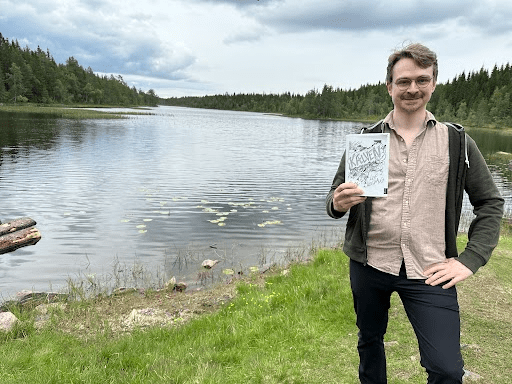
D: We worked quite closely together–I sent him a lot of questions via Messenger and he sent me several pages of explanations, including Norwegian cultural references and things. I got to spend a little time with him and his family early on in the project in Gran. I got to see the little lake that is called the Calf–the novel’s namesake.
U: The cultural references are really interesting. You mentioned in the translator’s note (which rocked) that you are from Georgia, when visiting Gran, did you feel like there were any cultural similarities?
D: In terms of cultural similarities, I guess I identified a little with the atmosphere of the book coming from 1980s culture so much. I grew up in the 80s and there seems to be this general widespread interest in the paranormal that bled across both sides of the Atlantic. Shows like Unsolved Mysteries and that shit. Which kind of shows up in the Calf because of the title character (purportedly) being a space alien. And then references to 80s horror films like the Chucky film franchise.
U: Yeah, horror movies know no borders. I loved having a glossary to consult, I loved having parts of the book to read aloud to fully get, it really made the whole reading experience feel almost more like storytelling almost, if that makes sense.
D: Yeah–I was influenced to include the glossary because of a translation I admire–Douglas Robinson’s translation from the Finnish of The Brothers Seven by Aleksis Kivi. He uses this sort of invented Shakespearean/Elizabethan English with a lot of weird and exotic words, and he includes a glossary at the end plus a ton of footnotes. I thought it might be a good idea since not all readers (especially not from the US, and Fum d’Estampa is a UK publisher) would maybe necessarily get the Southern US dialect.
U: I am sure it was really fun to regionalize terms for Norwegian sweaters.
D: Hah! Yes!
U: I found myself thinking about how speech and text intersect, how interesting it is that in English at least; we only really have a tradition for southern vernacular, like it would be totally wild to try to do this same thing with my New England accent.
D: Yeah, it’s interesting–like I said in the afterword I leaned most heavily on my dad’s spoken dialect. Other people in my immediate family have a Southern accent but not quite as pronounced as my dad. I myself have almost no Southern accent or dialect–mysteriously it did not catch on with me.
U: I absolutely loved your piece in LARB about Solstad & Mao (obviously I’m a fan), has that gained any traction with publishers? Can the English speaking world look forward to some Norwegian Communist Novels in their future?
D: Oh thank you! I sent it around to a handful of publishers in the wake of the article, I’ve gotten some interest but nothing set in stone just yet. Stay tuned.
U: You have to keep me posted!
D: Totally
U: Thank you so much for your time, I really appreciate it! I really loved The Calf, and I hope other people love it as much as I do.
D: Yeah thanks so much! I look forward to following the blog!
This interview has been edited for clarity and length.
 lønningspils
Leave a comment