
Review by Gregory Conway
Night Train To Nykøbing by Kristjana Gunnars.
Red Deer College Press.
86/100
Coach House Books was putting on their annual Wayzgoose in Toronto recently, a celebration they do every year to mark the end of summer and the start of the -working by candlelight- season. I was searching through their catalogue beforehand, anticipating I would likely buy some books, and came across Kristjana Gunnars. An unfamiliar name which led me into a deep dive on a writer who should be championed as one of greatest Canadian/Nordic writers.
Gunnars is an Icelandic-Canadian poet, master of autofiction, painter and professor born in 1948, Reykjavík. Their work has adapted and varied throughout their life, shifting from poems describing the Icelandic settlement experience, eco-criticism and literature that bounces between shades of Proust, Lispector and Annie Ernaux. Since 2020 they’ve been a guest professor at the University of Iceland working in Korean studies and asemic style of art and writing.
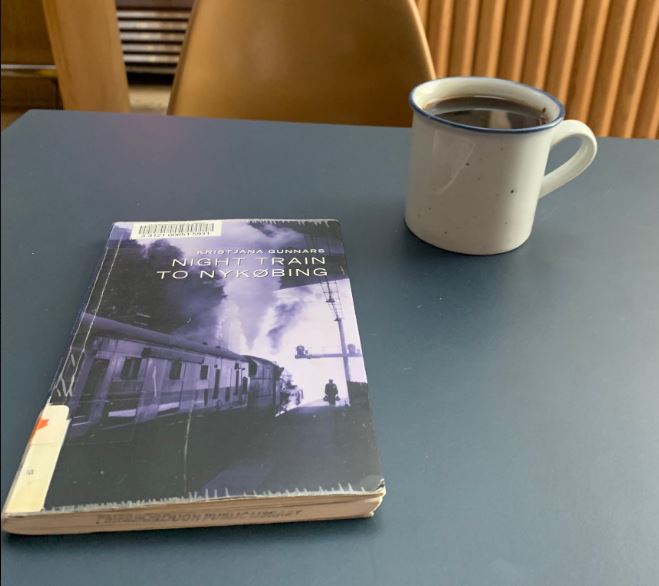
First published in 1996, Night Train to Nykøbing is a 96 page concentrated and blurry adventure of the heart. Essentially, our narrator leaves their lover standing at the train station as they depart, unsure when, if ever, they will see each other again. The book is told through a series of vignettes, 1-4 paragraphs each, which hop around through time and countries. The reader is taken to Copenhagen, Edmonton, Oslo, Paris and Vancouver in a whirlwind of yearning, love, sorrow and critical thought. Throughout the book we hear musings and thoughts on Munch’s The Sick Child, Clarice Lispector, Othello, Clarice Lispector, Italo Calvino, Clarice Lispector, Slavoj Žižek and Clarice Lispector; early on in the novel, our narrator buys a copy of The Stream of Life* by Clarice Lispector and makes reference to Lispector in 16 of the vignettes within this novel. The accentuation of Lispector acts as a structural support beam and shows how a person can engage with a text on a multitude of levels; in many ways this book is autofiction of a life alongside the text of Clarice Lispector and how reading and criticism fits into a life of family, friendship, love and work.
*[The 1988 translation title, newer English translations keep the original title Água Viva]
In one of the vignettes, our narrator who is presumably Kristjana, is at a banquet in Normandy with him and presents a short, endearing and sadly beautiful portrait of the late Icelandic writer, Guðbergur Bergsson:
When he looked at me across the table, his eyes were large and sad. The expression on his face was intense and seemed to say he had reason to be overly sensitive. I could not help thinking this must be how you look at a dinner companion you have decided to trust, if you have been abused earlier in life.
A prolific and underappreciated innovator in Icelandic-Canadian Literature who should be talked about in autofiction as much as Cusk or Ernaux. The ability to seamlessly incorporate small moments of earnest and fully-formed criticism in passing vignettes is unmatched.
FFO: Clarice Lispector. Annie Ernaux. Clarice Lispector. Marcel Proust. Clarice Lispector.
Though out of print as a standalone novel, it is currently available in “The Scent of Light” (2022) a collection of short novels by Kristjana Gunnars, put out by Coach House Books.
 lønningspils
Leave a comment