Review by Gregory Conway.
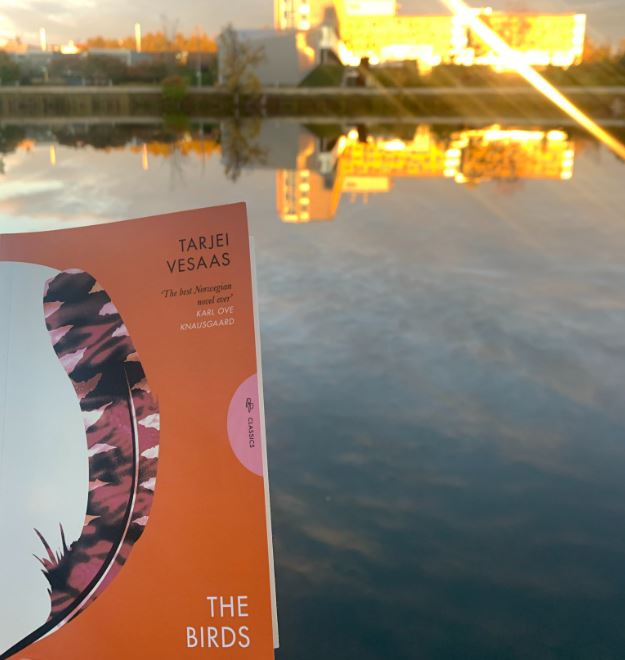
The Birds by Tarjei Vesaas.
Trans. by Torbjørn Støverud & Michael Barnes.
Pushkin Press.
100/100.
With the new editions published by Pushkin Press this month, it is an apt time to revisit what Karl Ove Knausgård describes as the best Norwegian novel ever. Karl Ove’s new introduction does tell us that Vesaas refused to live in Norway’s honorary residence for artists, which is currently home to Jon Fosse, and that generally he avoided the public, awards, press and recognition.
****
****
This book is a stunning display of literature, at once a tender exploration into the mind of an intellectually-disabled man, a tall-dark stranger lumberjack romance novel, a glimpse into the relationship of a brother and sister and a harsh critique of modernity.
Mattis, our protagonist who is often called Simple Simon in his tiny town, lives with his sister, Hege. His difficulties prevent him from working and they live on the meagre income of Hege’s knitting. We feel Hege’s love and patience with Mattis throughout the novel. It’s easy to empathize with him, but easier to feel for Hege, a frustrating and lovable character. We follow Mattis as he fails at working with turnips and explores nature. Mattis is intertwined with nature in a fragile and deep-connected way, he is on a knife’s edge with the flight pattern of a woodcock, sees symbols in trees and lightning every time he saw something beautiful, he stopped automatically.
Mattis eventually attempts a fool’s errand of a job, ferrying to-and-from an island nobody would ever use- except one day he stumbles across Jørgen, a lumberjack, looking to cross the lake. Jørgen finds work nearby and falls in love with Mattis’s sister Hege, bringing a disturbance and chaos to his mind. He fears his sister will eventually abandon him and his fear eventually leads to his demise.
****
The logging industry in Norway heavily depleted the forests of the southern part of the country and sustainability and replanting efforts really didn’t come along well into the life of Vesaas. In many ways this is a primitivist novel, where boats, cars, the need to earn money and modernization are the enemy, Jørgen’s work site as a lumberjack which provides them more and better food, when seen by Mattis is described as a battlefield. Mattis’s father was also killed in a workplace accident that is never explained within the novel, it’s just a thing that can happen. Mattis’s obsession and connection with the woodcock also shows the tranquility of nature opposed to modernity, when Mattis somewhat unknowingly tells a hunter about the bird: The evening sky was flooding the clearing with light, yet from somewhere in among the bushes the barrel of a gun was probably poking out. This had a paralysing and shattering effect on everything.
****
Tarjei Vesaas is up there with Knut Hamsun, Henrik Ibsen, Jon Fosse and Karl Ove Knausgård on the Rushmore of Nordic Literature. He bridges the gap between early neo-romantic and naturalistic novels into contemporary works. Between novels like Hamsun’s “Growth of The Soil” or “Pan” stands Tarjei Vesaas, between the past and hyper-modern books by Vigdis Hjorth, Jenny Hval, or Dag Solstad. As time changes and literature changes in Norway, Vesaas represents not just his era, but the totality of Norwegian Literature.
****
FFO: Knut Hamsun, Halldór Laxness, Samuel Beckett.
Buy Here.
 lønningspils
Leave a comment