
Review by Gregory Conway.
The Ice Palace by Tarjei Vesaas.
Trans. by Elizabeth Rokkan.
Pushkin Press.
100/100.
“Northern races are the tragic races- they don’t indulge in the cheering luxury of tears”. A line spoken to Sally Carrol Happer after discussing Ibsen, written by F. Scott Fitzgerald for The Saturday Evening Post in 1920, in his short story The Ice Palace. This story does not only share a title, also howling winds, frigid temperatures and the namesake palace. 43 years before Tarjei Vesaas, Fitzgerald has his character traverse a powdery wraith of loose snow to an ice spectacle, in Fitzgerald’s case man-made, rather than Vesaas’s waterfall rime. Sally and Unn both find themselves amazed and awe-struck by the ice palace and its reflective surfaces, eventually both ending up lost and alone, dropping temperature, crying with their minds finding both confusion and clarity.
“You’re not crying,” something said aloud. “You’ll never cry any more. Your tears will just freeze: all tears freeze up here!” (Sally, FItzgerald)
Suddenly she understood, now she could see it clearly: it had been herself crying so hard in there. She did not know why, but it had been herself, plunged in her own tears. (Unn, Vesaas)
Ice forms on the shoes of Sally, ice forms on Unn’s coat and the cold turns to warmth, drowsiness sets in and the eyelids close to sleep. Sally is found and woken up, leaves for the south, she’s changed and given clarity in the ice palace. Before sleeping, Unn has every scrap of guilty conscience vanished and feels that nothing can be more right; it is finally the moment she can move past her mother’s death, but unlike Sally, Unn is never shaken awake and saved. Unn is never able to leave her ice palace.
****
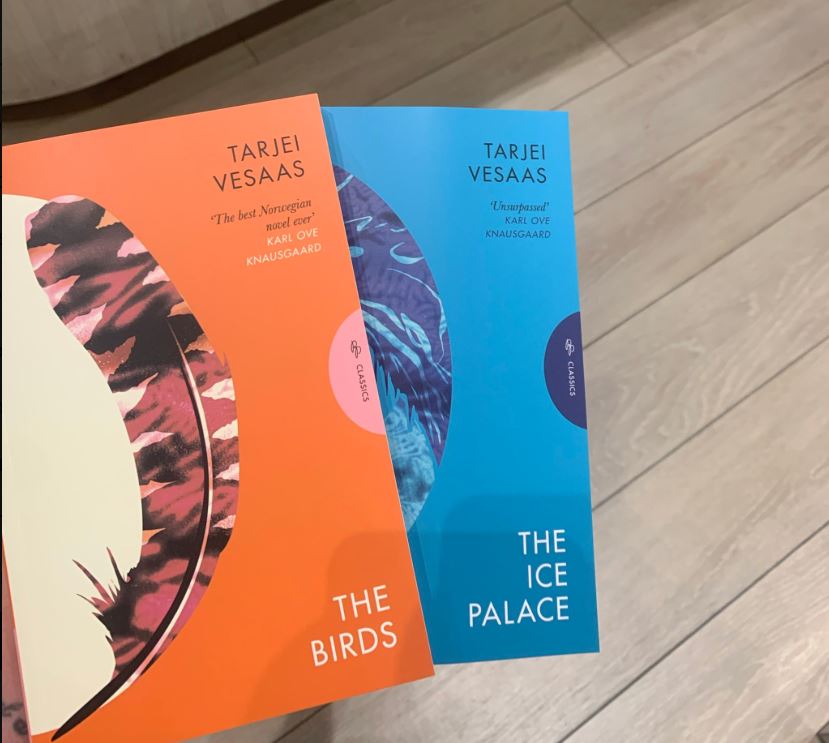
Tarjei Vesaas was a prolific Norwegian writer, often noted as Norwegian’s best. He wrote several novels, plays and poems throughout his life, 1897-1970, though two late career novels are considered his best. The Birds (1957) and The Ice Palace (1963). There is an under-read and underappreciated experimental phase, works written under German occupation, a tetralogy and early romantic / religious works more in the vein of Knut Hamsun.
****
The plot focuses on a pair of 11 year old girls in a brutal winter season in rural Norway. Siss, the most popular girl in school, and Unn, a reserved and grief-struck orphan who has just moved in to live with her aunt in Siss’s village. Unn sits alone, does not play with the other girls and refuses to participate, her grief holding her hostage despite all of the other girls wanting to meet and include her. Eventually Siss and Unn are able to break through and meet in one of the most beautiful and intimate scenes I’ve ever encountered. The connection, confusion and misplaced emotions and beauty of young female friendship is depicted as vividly, panoramic and raw as anything by Elena Ferrante in a concise 14 pages. After their connection, Unn is hopeful, overwhelmed and nervous and decides to skip a day of school before seeing Siss again. To kill the day away from school and away from home, Unn goes to visit the ice palace, a structure made of ice surrounding a waterfall nearby their school. The beauty of the structure brings Unn into its cavernous depths where eventually she ends up lost, confused and falls asleep, freezing to death.
The rest of the novel concerns the search for Unn and the psychological strain it puts on Siss and Unn’s aunt. With Siss held captive and eventually released from grief’s own ice palace.
****
The novel is told with a sparse spartan prose during the scenes which pack a heavy emotional punch, while flourishes and beautiful passages are often reserved for scenic descriptors and the environment, the tussocks and rime.
Though mainly a classic linear novel, we do see Vesaas dip his toes into the icy waters of magical realism with a group of woodwind players following Siss, scoring the novel’s mood and atmosphere. We see features of experimentation with one chapter being a poem, another written from the perspective of a bird, though the traditionally told scene where Unn’s aunt and Siss go for a walk throughout the village is one of the most heart-wrenching moments in Nordic literature.
****
****
The intimate scene between Siss and Unn, in a locked bedroom and pre-teens has certainly had queer readings and scholarship. The nerves. Invested and intense. Siss and Unn remove their clothes and expose themselves to each other, after Unn opens up about the death of her mother and leaves herself bare. Giddy and confused, misreading of signals. The nudity is less intimate than their clothed actions; Unn pulls down a mirror off the wall and asks Siss to come near, together they gaze into the mirror from different angles and distortions, a different sort of reflection which moves them, changes them. It is too much to handle and Siss runs home, thinking Unn is strange and beautiful and shy, they will never meet again.
****
The novel creates characters out of the environment. This book cannot exist without the haunting and dangerous beauty of a destructive and picturesque Norwegian winter. This is an environmental novel. We see the face of nature in the reflection of the ice, we see Siss change her relationship with the darkness of the Nordic winter, On her way home from the intimate moment with Unn, Siss is spoken to by the darkness: It is I at the sides of the road… I’m Coming… when Unn’s Aunt finishes her walk with Siss, later in the novel, we find Siss floating, almost at one with the darkness. We move from an eco-horror to a dark peacefulness.
It is thoughtful to consider the Norwegian releases of the current day and how modernity and climate chaos has changed the role of the environment in literature, if only since the time of Vesaas in the 60s. Rain, thaw, receding and the unforgiving beauty of the landscape is a central character in The Ice Palace, a perfect novel.
FFO: Knut Hamsun, Elena Ferrante, Halldór Laxness, Samuel Beckett.
Buy Here.
 lønningspils
Leave a comment