
Review by Ursula Carroll.
Anatomy. Monotony. by Edy Poppy,
Trans. by May-Brit Akerholt.
Dalkey Archive
83/100
Anatomy. Monotony. is gripping, it is fast, it is unabashed. It is a book with nothing to hide. Norwegian multi-hypenate writer Edy Poppy paints a picture of an excited, messy, exhausting period of time in her life. In an autofictional account of her own open marriage, Poppy does not hold back. She is a feminist, writing openly and honestly. She is not afraid to walk on the edge of taboo, exploring subjects that are still kept under wraps.
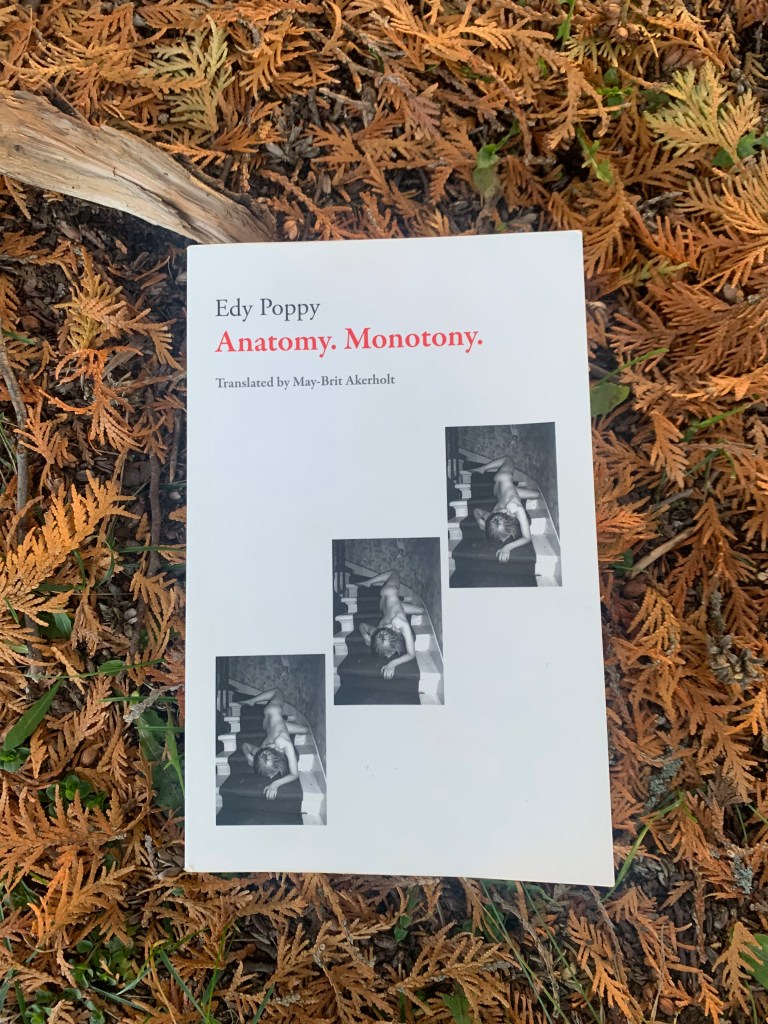
Vår, the stand-in for Poppy herself, is a writer and life model. Vår is married to Lou, the husband stand-in. We are given periodic excerpts from Vår’s novel in progress, in which she is writing the real story of Poppy and her husband, using their real birth names, Ragnhild and Cyril. It is autofiction within autofiction, allowing for an intimacy and honesty that singles this book out as something special. The reader is kept close with vivid, visceral vignettes as Vår tests the limits of her marriage. Vår loves Lou and Vår loves other men, Ragnhild loves Cyril and Ragnhild loves other men. Poppy paints a life of excitement, full of pleasure. This lifestyle is not without moments of intense anguish.
In exchange for all the joy, love, and happiness; Vår and Lou, Ragnhild and Cyril continually hurt each other. It is the nature of their relationships, the hurting is welcome and expected. Bleak trips and trysts, love games, emotional chess; for the sake of pleasure and with the assumed pain. They are faced with the central question: how much suffering is love worth? Her characters go to extreme lengths to find out.
Poppy lays out the pleasure in detail, describing bodies, their shapes and sensations exceedingly well. She uses sexuality as fuel and a mirror. Sexual moments push and bend the relationships, they color the moods. It’s the tool used to examine humanity and womanhood.
In 1975 Helene Cixous wrote
“Woman must write herself: must write about women and bring women to writing, from which they have been driven away as violently as from their bodies”. Poppy does just this. She shirks phallocentric writing, this book is feminine and feminist. Vår and Ragnhild are pleasure seeking women. Poppy has created female characters that are sexually liberated, unafraid and unabashed. In the tradition of Écriture féminine, Poppy writes from a woman’s perspective. She claims her character’s body as her own.
In The Laugh of the Medusa, Cixous continues,
I have been amazed more than once by a description a woman gave me of a world all her own which she had been secretly haunting since early childhood. A world of searching, the elaboration of a knowledge, on the basis of a systematic experimentation with the bodily functions, a passionate and precise interrogation of her erotogeneity.
Writing about female sexuality remains taboo. It is hidden away, behind idioms and metaphors. Poppy flaunts this, using direct language to describe sensations,, the human condition, and the feminine perspective. The female experience takes shape as petulance, loneliness, shame, eroticism, maternal instinct; a familiar form.
It is inherently radical for women to write her full truth, unflinching and unafraid. Though good liberals might believe we — the liberated 21st century women — are on the same level as men. It is just not the case. Cixous wrote in 1975 “Writing is for you, you are for you; your body is yours, take it. I know why you haven’t written…. Because writing is at once too high, too great for you, it’s reserved for the great— that is, for ‘great men’; and it’s “silly.” In literature, men are more well respected. Men receive the most awards. 15% of Nobel laureates are women. 33% of Booker Prize winners are women. 29% of Nordic Council Literature Prize winners are women. Men can write intensely intimate and revealing autofiction, going on and on about their sexuality, feelings, experiences and it is groundbreaking. Revolutionary. “You simply must read it.” Women, especially French women, have been writing in this tradition for ages. Have you read them? Men can write sexual, non pornographic novels (see Seinfeld episode The Library, s3 e22) and everybody reads them their freshman year of college. Can women? Can we have the same respect? Can our work receive the same treatment? Someday it will no longer be radical for a woman to write. Poppy’s work, her fearlessness, is bringing us one step closer.
FFO: Marguerite Duras, George Sand, Colette, Simone De Beauvoir, Agent Provacateur, The Marble Index
 lønningspils
Leave a comment