
By Penelope Dieppa
The first time I heard the name Knausgård was, in a very Gen-Z fashion, when Siobhan Roy evoked his name in Season 3, Episode 5 of HBO’s Succession in reference to activities Tom Wambsgans could pursue while spending time in prison for destroying incriminating documents.
I googled him during the episode and discovered he wrote six books about his life, My Struggle, the series being controversial for how revealing the autobiographical elements of the text were, not only for Knausgård but for his family and so I placed the first one neatly in my “Want to Read” shelf on Goodreads. Who wouldn’t want to read something controversial, and sharing a name with a certain German politician’s book piqued my interest further. I had no idea who he really was, how the books were written, or anything. The concept simply sounded interesting.
I bought my first Knausgård book, My Struggle: Book One, sometime in late winter 2024 from a small used-bookstore in Manhattan, Codex. I remember the cashier, a young woman around the same age as me, saying she loved the series. I told her the anecdote about its mention on Succession as she rang me up though she said she hadn’t yet seen it.
I started Book One on April 17th, 2024 and finished Book Six on October 6th, 2025. My two standouts being Book Two and Five, which I now own signed copies of.
What I love the most about My Struggle, what I always wish to get back into and lost within, are those many sequences that pepper each of them finely, where he describes days in full and at length. Each day unique yet similar, he wakes, he eats, he goes wherever he goes, we learn something about someone, he goes back and forth between his children’s daycare and his apartment, losing his phone on the train, walking around Bergen at night hoping to spot someone he knows. We grow with him when he forces himself to eat cereal with expired milk so as to not upset his emotionally abusive father. When he pleads with his parents to buy him a boy’s swimming cap, when they divorce and his father brightens, when he falls in love with a Danish girl or an American girl or the girl from school, Tonje, Linda. It feels at points I have lived another life, I get confused where my own experiences start and his end. When I recall moments from the book it feels as if his life has affected mine in equal measure as my own first romantic experience, my own relationship with my father, my own feelings of isolation as a child.
I recently had the privilege of seeing the man in person, for Historia. Which had its debut in New York at the 92 Street Y, commissioned by them along with Liquid Music and Northrop at The University of Minnesota, where it’s second performance was held. The event, held in collaboration with Wilco drummer Glenn Kotche, along with visuals by Swedish film director Johan Renck, is summarized by Kotche in the program as, “an evening of storytelling through the individual lenses of words, sound, and image as well as through the amalgamation of these mediums in a truly unique live performance setting.” Nowhere is it clarified what will actually occur during Historia besides guarantee that we will hear Kotche’s Monkey Chant, a reading from Knausgård’s forthcoming novel The School of Night, and Renck’s short film The Left Shore. The man who came out to introduce the show said it will be, “something you’ve never seen before.” And I couldn’t come up with a better description for whatever it is I witnessed.
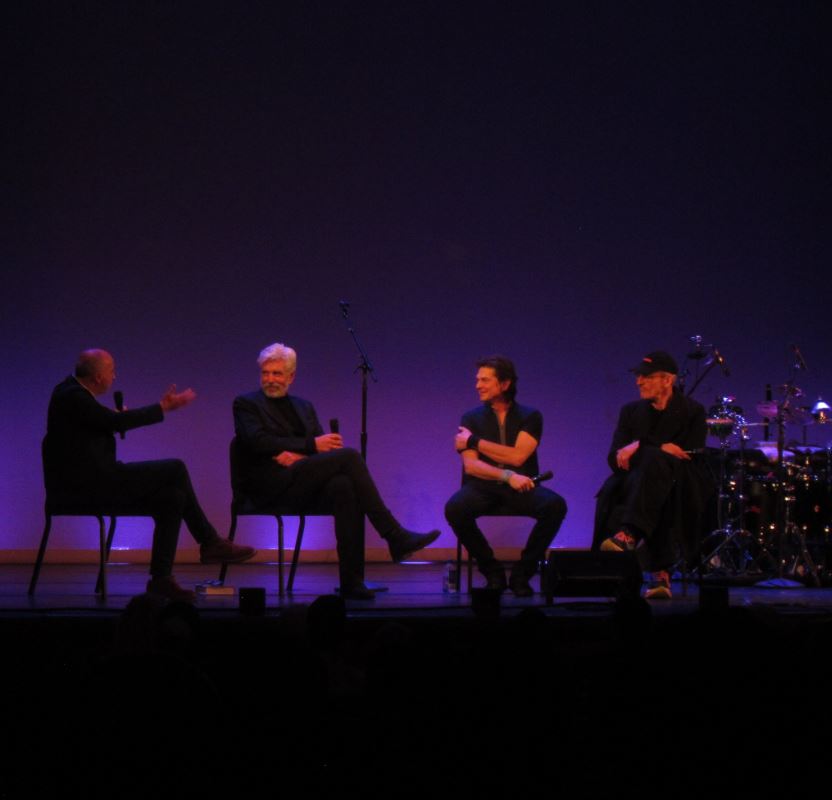
It began with Kotche entering the stage, to applause, to turn on cricket sounds from a sorta console that sat behind his elaborate drum set. Kotche played Monkey Chant, a solo percussion piece, composed by him, in which he utilizes a standard drum kit, “prepared drums” (a term he takes from John Cage’s ‘prepared piano’), bells, xylophones, pulled wire and other things that I’m not sure have actual names. Kotche wrote in the program and discussed in the Q&A, hosted by the flat and boring James Wood, about how Monkey Chant was inspired by the Balinese Monkey Chant (Ketjak) which is traditionally a large performance piece with upwards of hundreds of people singing, dancing, and acting out a portion of the Hindu epic, Ramayana.
I really — really enjoyed Monkey Chant and, to be frank, the only Wilco song I’ve ever listened to was Heavy Metal Drummer, so it was a pleasant surprise that Kotche’s section of the evening was worth the excitement I had for the coming attraction. Monkey Chant reminded me of Cristobal Tapia De Veer’s White Lotus soundtrack. With quick pace and ever building tension, I could understand the narrative layer hidden beneath Kotche’s rhythms.
So, with Monkey Chant over, and more applause, the Norwegian appeared from behind the curtain. Firstly, he has such white hair. Like blindingly white, it was not grey, not ecru nor ivory, not eggshell nor alabaster — it was White.
He began reading from The School of Night with no introduction, no extra words, just lifted the white computer paper (which felt beige next to his locks) and began reading. I have no idea where in the book this takes place but I’ll describe what I heard, so spoilers. Though it was also for everyone in the audience since The School of Night comes out in January of next year. Though the UK gets a head start with a November 6th release.
It started with a beautiful allegory about how humanity is like snowflakes, 8 billion snowflakes currently, falling and twisting around each other, passing other snowflakes we know as strangers or family. One day we will reach the ground and join the rest of humanity down there. Eventually, as the billions of snowflakes still waiting to fall begin their descent, the “blizzard of the unborn” he describes it as, enjoying their own time in the sky before reaching the ground, laying on the resting place of all humanity, they will cover us. And keep covering us. Until we, as a singular snowflake, are effectively meaningless in a field of trillions of snowflakes, who will never fall again.
He then goes into the actual narrative, again not sure how these are linked since if I recall correctly it felt a bit clunky getting between them. But also, to clarify, I think I blacked out a bit. I was so enamored with seeing him — him — Karl Ove Knausgård — just feet away from me — there — reading an unreleased English translation, words that I’ve never heard before, coming directly from his mouth, all just for me. He appeared in a glow, like the effect Apple has coded when you select a subject in the photos app, giving the person or object a shimmering aura. That is how he appeared. I had my small notebook covering my agape mouth as he read that portion on snowflakes and after a few minutes of keeping it there, I pulled away only to realize I had drooled a small amount onto it. My head felt light and all of my energy was in my ears – eyes – brain; seeing him – listening to him – thinking about those things in collaboration.
So began the narrative of Kristian biking to a woman’s apartment and on his way there, stops in front of a church, smokes a cigarette, and is asked by a homeless man if he has an extra. After giving the man two cigarettes and a light, the homeless man pockets Kristian’s lighter. “That was the thing about being good, it easily got out of hand,” got a big laugh from the audience. Kristian asks him for the lighter back and the man feigns ignorance, “What lighter?”
Kristian then reaches for the man’s coat pocket, the man grasping Kristian’s wrist, Kristian lifting his hand to the man’s face and pushing it back, though I can’t remember the exact turn of phrase Knausgård used. Kristian realizes the man’s eyes have become vacant, his grasp on the wrist limp. He has died. There’s no one else around and so Kristian, consciously, terrified, calmly, takes the lighter from the man’s coat, gets onto his bike, and pedals away as if nothing had happened. He arrives at Vivienne’s apartment, who’s been waiting hours for his arrival, and washes his hands.
Then Knausgård stops reading. The lights change in the room. It is silent. Kotche enters the stage. No applause. He sits behind his drum set and starts playing. Knausgård watches him from behind the microphone. After a while, at a seemingly planned interval, Knausgård continues reading whilst Kotche plays.
This following section was when Historia truly began since, soon after Knausgård started reading again, The Left Shore, a video made in collaboration between Renck and Swedish photographer Anders Petersen, currently on display at the Nationalmuseum in Stockholm, started playing onstage. Images of women and men, animals and still life, old and young. Some people in underwear, some people with tattoos, all black and white, all very moody. “Fringe characters and ominous scenery,” is how Kotche describes it in the program. What was odd about the images were that they moved, and while that doesn’t sound too odd — we’ve had video technology for over 100 years at this point — it was how they moved that was so… specific.
That man from the beginning again, the man who introduced us, at the end of his little spiel said how glad he was that we were all seeing something creative, especially in the era of AI. This too got a bit of applause. I wrote in my notebook, “AI of course” and honestly didn’t think it would come up again. I mean where is AI going to fit into this weird fusion of a Norwegian writer, American drummer, and Swedish director? The Left Shore was made, “with the help of AI technology,” as reported by the Sweden Herald, this fact missing from the event’s program.
“It looked like AI almost, though I doubt they would use AI,” is what I naively wrote in my notebook.
Knausgård continues reading, it is now morning, Kristian having an internal crisis over his actions from the night before. He goes out, buys a newspaper, talks to a man referred to as ‘The Egyptian’ if I heard correctly, who pesters Kristian as if he knows all about the murder. To prevent taking the same train as him, Kristian goes to the cafe across the street to read the paper. Inside he sees a picture of himself from last night. Knausgård begins reading a long internal monologue in classic Knausgårdian fashion all about the effect this newspaper will have on him, how everyone knows it’s him in the picture, how his life is now entirely changed. Classic Knausgård stuff.
The video keeps playing on the screen beyond, its figures shifting in grotesque uncanny-valley mannerisms, Kotche still on the drums.
Kristian then goes back to his flat since he has to get rid of his identifiable jacket he wore in the photograph. He wants to write in his notebook all about it, but can’t find it. He searches his entire one room flat, the bathroom through the landing, pouring out the contents of his bag, nowhere. Soon he hears a person walking up the steps to his apartment, he freezes, his mail flap opens, a thin package flops onto the floor. He opens the package and sees a photograph of a Parisian street, Boulevard du Temple. On the back is written something akin to, “What’s dead is dead.”
“Choose life Kristian.”
Knausgård’s reading from The School of Night was complete. He walked off stage. Applause. Kotche played another song, lots of bells, applause, the Q&A.
Knausgård admitted the whole trio was “very recent” Renck’s inclusion being added after Kotche and Knausgård agreed to work together. In regards to the reasoning behind Historia, Knausgård talked about how with writing, because it is so solitary, a writer can never ensure an experience. Everyone will interpret passages differently, the intended emotional journey can become lost as you leave books behind or life interjects beyond the dust jacket, the author’s intent muddled, people lead astray.
What he says though is that what we have just witnessed — Knausgård reading from The School of Night as Kotche improvises on the drum kit and an AI-edited video plays on a big screen behind both of them — is closer to how The School of Night is meant to be experienced.
On the book itself, It’s not exactly a secret that The School of Night is Faustian story, it’s referred to as, “a twist on Christopher Marlowe’s Doctor Faustus” on Penguin Random House’s website and so Knausgård’s description of the novel when asked largely hinged on that aspect as well. Though other, deeper insights sprung up, specifically that photo, Boulevard du Temple, which Knausgård clearly had some recent intrigue with. He said the image creeps him out, that there’s evil in it, the audience laughed. Knausgård says the picture, which should be of a busy Parisian street in the middle of the day, is mysteriously empty, and that the only figure in it, the only person, standing on the street, black in shadow, has to be the devil. Another light laugh. I too found this funny, it’s a very Knausgård thing. If you’ve read A Time For Everything you can better understand how and where Knausgård will see things and distort them slightly or make generalizations when needed to have a stronger effect. And it works beautifully in that book. Though of course the reason there are no people in the photograph is because they were all moving and so blurred into non-existence, and the figure Knausgård references is actually two people, a shoeshiner and his client. Knausgård is still Knausgård.
“The worst thing that can happen to a human being happens to him,” he said ominously in reference to Kristian. He then went on to say what the worst thing that can happen to a human being is, laughing at accidentally spoiling a part of the book. Knausgård also talked about Kristian as a character, whose realization that he lacks empathy, for anybody, gives him great advantages as an artist. Allowing him to climb the ladder without worry of stepping on others to get there.
On the setting of London for the novel, Knausgård said that when he was young in the 80s, London was the place he always wanted to go. London was the place to be. With all of its music and bands and art and culture, everything for Knausgård was happening in London yet all he could do was watch from a distance, trapped in between the fjords. So he knew the novel would be set in London, in the 80s, for that exact reason, so he could then live that dream of his youth. He says all the music he loved and wanted to be a part of is referenced in the novel, which I am excited for. I keep telling my father to read My Struggle, not only because he and Knausgård are around the same age, but also because so much of the music my father has shown me Knausgård directly references. Echo & The Bunnymen, Talking Heads, U2, The Police, the list goes on.
Speaking of music, Knausgård finished the event with a passage from Out of The World… in English. Notable since, although the novel, his debut, was first published in 1998, it has yet to see an English translation, with its publishing date continuously pushed back, now scheduled as February of 2028. I could probably gain a reading-level of Bokmål and read Ute av verden before we even get a cover for it. The section he read for us concerned the narrator sorting out a record collection, as Kotche improvised a much louder and brash accompanying drum piece. It was very exciting how passionate the narrator was in regards to band orders and what not, the best ways to listen. I let the music have a bigger sway for this reading, no longer straining my ears to listen to every syllable coming out of the Norwegian’s mouth. This section also lacked a visual element. Knausgård and Kotche finished. Applause. They left the stage. Then they came back, with Renck, applause again. Lots of people stood, I stood, lots of people also did not.
And so ends Historia, which happened again at the University of Minnesota on November 2nd, and so I’m very glad more people got to see this bizarre show.
Now that I have my rose-colored glasses burned clean off, turned cinder by the refractions of the stage lights from Knausgård’s blisteringly white hair: Historia was a terrible way to experience a book.
That is not to say its individual parts were bad, the writing was captivating as always, Kotche was amazing on the drums — definitely planning on listening to more of his solo-work, and Renck’s AI video was… a bit bad. All together though they made a deeply confusing and overstimulating mess where if you were interested in one section of the piece — I assume most people were interested in hearing The School of Night — the other aspects, the music and video, became things you had to try to ignore. If you’ve ever watched Young Sheldon with Mandarin subtitles on TikTok with Subway Surfers gameplay underneath it, you’ve experienced Historia.
 lønningspils
Leave a comment