
Review by Gregory Conway
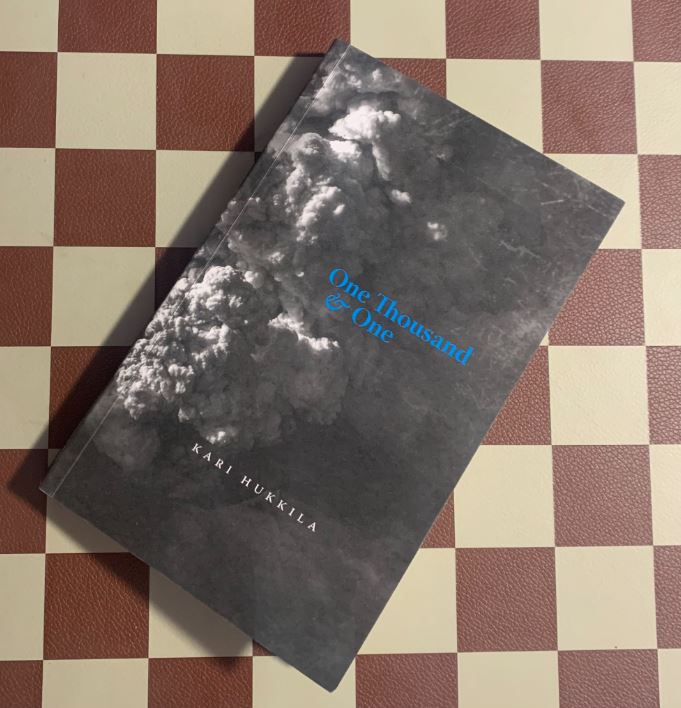
One Thousand & One by Kari Hukkila,
Trans. by David Hackston.
Contra Mundum Press
95/100
****
****
A lot of my winter driving this holiday season has been soundtracked by the audiobook An Angel Walks Through The Stage And Other Essays by Jon Fosse (translated by May-Brit Akerholt and read by Kåre Conradi). This collection of essays includes a piece on the philosopher Ludwig Wittgenstein called “For The Sun To Rise”. Wittgenstein heavily influenced Fosse, in his essay he talks about the diary the philosopher kept in his Norwegian cabin in Skjolden. Though Ludde* (Ludwig Wittgenstein) composed large portions of his fundamental text Tractatus Logico-Philosophicus during this period, the diary focused on the sun. Wittgenstein dreaded the darkness Norway sees through the winter and kept his diary predominantly about missing the light. Nothing preoccupied his diary as much as the light coming back, day after day in the dark winter waiting for the sun – rejoicing when it arrives, the light has arrived.
It is easy to see this obsession with the repetition of arriving light get its footing in the prose of Jon Fosse. Fosse’s masterpieces came about later in his career, Trilogy (2014), Septology (2019), where his essay writing concluded at the end of the 1990s. It is interesting to draw these thoughts about Wittgenstein in both periods of his career, the separate essay and the separate novel.
****
In another country I have found another writer dedicating a heavy word-count to Ludwig Wittgenstein, Kari Hukkila. This time not separating the novel and the essay. The “essayistic novel” One Thousand & One (2016) blends the two forms. Though we are reversing Wittgenstein’s nordic retreat as we see our narrator leave Finland for Italy.
****
The book is described on the back cover as an essayistic novel about “humans’ ability to respond to catastrophes” and this is certainly true. We get digressions and a biographical understanding of Ludwig Wittgenstein, but this is not plotless fiction.
The novel opens with a retreat from Helsinki to a cabin in Uukuniemi near the Russian border of Finland. Our narrator had been planning to work on a writing project about Wittgenstein. Upon arriving at the Swedish-style cottage, he finds two tall fallen and unmoveable birch trees blocking access to the door. He is reminded of a promise to visit an old friend, Mara, a former fellow Wittgenstein scholar who is living in Rome… and but so we go.
After touching down in Italy, Mara informs our narrator about a tempestuous sexual relationship he’s been having with a southern Italian man, Kurre, who turns out to not be Italian, but an “illegal” Ethiopian in Rome. We learn Kurre has lost his housing, had moved a couple times in the past month and the three meet for drinks while Kurre arrives with most of his worldly possessions in tow. We learn Kurre is a pretty unpleasant drunk when “he ordered one beer after another, which an anxious-looking Mara duly paid for”; the power dynamics of money in a relationship like this do not need to be explained. As Kurre descends into the drink, after exclaiming his love of Nordic clear spirits while drinking Polish vodka, the novel really builds tension, feeling the evening could collapse into chaos at any moment.
The relationship between Mara and Kurre is really the crux of the plot. Kurre’s attempt to cross the Italian border from Turin into Scandinavia and the cut off of communication and fear Mara has for Kurre travelling is incredibly touching. Would he be deported to Ethiopia? Imprisoned? Would he just never hear anything ever again?
“I thought Kurre was needy and vulnerable and I’d seen the way he flagrantly abused Mara’s kindness, but however complex a web of abusive bonds existed between them, I’d witnessed a few sincere moments between them too, and that was enough”.
****
Ever-lurking in the mind of the narrator is also his decaying fraught relationship with his brother. He was nine years his junior, living in Turku, and “active on a number of anti-immigration nonsense forums”. They have a bit of a spat at a family dinner and it weighs on our narrator’s mind.
Brotherhood conveys itself in many ways in Hukkila’s work, we see Mara and the narrator as brothers, we see “Ultimately, Mara and the Ethiopian are the kind of brothers that curiously complement each other”, we see humanity as brotherhood that transcends borders and we see the tragic fate of Ludwig Wittgenstein’s brothers:The oldest of Wittgenstein’s four brothers disappeared on a boat trip in the Chesapeake Bay in circumstances that led the family to consider his death a suicide. This was then followed by another brother’s suicide in Berlin, the third shot himself during the dying days of the First World War, and the fourth, who had dedicated his life to becoming a concert pianist, lost his right arm in the war, which was such a great loss that there was simply no point committing suicide.
Our narrator’s arguement and relationship with his brother ends up inspiring him to write on Gustaw Herling, a Polish writer known for his first-hand account of the Soviet Gulag, “Later, while living in Naples, Herling turned his gulag-weary eyes to earthquakes and other local catastrophes and saw in them the patterns he witnessed in the camps”. The book continually checks in on the life of Herling, his work and other natural and man-made disasters.
****
Mara tells our narrator about how WIttgenstein renounced his family’s wealth and inheritance, arguing that he was not only escaping his past and family ties, but imagining that without an inheritance he was trying to live in denial, behaving as if his father’s death never happened. We are treated to a poetic and lyric re-telling of Ludde’s life which is unmatched in showing the emotional life of the philosopher.
Mara makes the argument that Tractatus was “the best war book he’d ever read”, mentioning Wittgenstein’s spring of 1916 where he had already started working on the work; he asked to be assigned to the most dangerous places in the war, eventually being sent to an observation post where he would essentially be a sitting duck. “Most nights, he thought he was going to die and prayed to God for the fortitude to look death in the eye all night”, Mara believing this incident, and his survival, expanded his book from “the foundation of logic to the very essence of the world”.
****
There is so much more to discuss in depth, the book is a real treasure that rewards second glances. There is in depth coverage of Gunnar Björling – his poems, life, sexuality and critical reception. There is so much to dive into from an environmental lens – forestry in Finland, pine trees, “laurel trees, holm oaks, sage and gorse”,fog, snow, volcanoes: these are all characters and active participants in this novel, even ants. Near the end of the novel there is a particular moving section about ant colonies, collective memory, individuality and the way ants turn simple encounters on their path into decisions on “how to dig a tunnel and where to pile the bodies”.
This is a criminally underrated gem of literature, not just of nordic literature. There is a record by, the band, Refused called The Shape Of Punk To Come, which had an innovative sound and pushed genre convictions, but the genre of punk went in a different, and worse, direction. Kari Hukkila is pushing the form of the novel in a similar way, in a publishing landscape where overly maximalist zany tomes are the popular boundary pushing form, I wish there were more novels pushing in this direction.
****
FFO: Kristjana Gunnars, A.V. Marraccini, Ludwig Wittgenstein, Benjamin Labatut.
Buy Here.
 lønningspils
Leave a comment