By Gregory Conway.
Dr. Maya Weeks is a true multi-hyphenate of everything valued at Lønningspils HQ: a feminist political ecologist, writer, poet and translator. She translated the author’s note to Tove Jansson’s Sun City for NYBR and works on oceans, pollution, gender and biodegradable wool production on Northern Chumash and Salinan land, California.
****
LP: Hi Maya! Thank you for joining the Lønningspils Google Chat. Up in Peterborough we are slowly thawing out being snowed in, how is California today?
MW: Thanks so much for having me; I so appreciate and enjoy reading Lønningspils! Here, where I am on the Central Coast of California — Northern Chumash and Salinan land — we are having some sun breaking through clouds, which I am so happy about!
LP: Some January sun is always a pleasure to see.
We will certainly touch on California, but I wanted to start us off someone a little further away, in Finland.
This week I’ve been on a real Tove Jansson binge. Getting through Summer Book, Sun City and recklessly spamming Moomin drawings in texts and group chats. This was my first encounter with Sun City (1974), Jansson’s novel set in Florida, which was re-released by NYRB last February. You translated the author’s note from Swedish for this new edition, could you tell me about how this project came about and your history with Swedish / Translation?
MW: Rad. First off, I have to say Tove Jansson is one of my very favorite artists. I was so, so happy and honored to get to translate her. I learned Swedish as an exchange student in Sweden in high school: I did a ton of fundraising etc. in high school to be able to study abroad for a year, which really changed my life coming from a working-class family in a rural town. I lived with a host family on the west coast of Sweden, who generously brought me in as their own and with whom I learned Swedish by immersion (both living with them and attending gymnasium). I’ve always loved languages and actually considered pursuing a translation career in my early 20s but continued to pursue the arts and environmental work “instead.” I say “instead” because I definitely aim to continue doing polylingual work, translation, etc. I wound up doing the translation of the author’s note because a friend of mine from undergraduate study in linguistics at the University of California, Santa Cruz, Max Fox had seen on at-the-time Twitter that NYRB was looking for a translator for the note. He flagged it for me, I reached out to them, and next thing I knew, I had a photo of Tove Jansson’s note in her handwriting in my inbox to sit with. It gave me chills, tbh!
****
LP: Florida is a very interesting space for both literature and being visually reminded of climate change, pollution and community – elements all integral to your work.
Sun City, set in Florida, is often lauded with praise for its depiction of the “everyday life of the aged”, it also really interesting from an enviornmental perspective. There is a moment when the residents commiserate on palm trees looking like “miserable stumps” as they recover & jokes that aren’t quite jokes of climate anxiety – old people being skewered by trees in tropical storms. Even how the ship Bounty, mentioned in the book ended up being destroyed in Hurricane Sandy.
You have also done work in Florida – Can you tell me a little bit about your time researching marine debris off Florida in the Gulf Stream?
MW: That’s so true, and absolutely. I sailed from Key West, Florida to Bermuda in 2017 for research on marine plastic pollution. I had started writing a hybrid poetry book on plastic pollution from a materialist feminist perspective in 2013 and I badly wanted to go to sea to experience — and I say “experience” because so much plastic pollution in the oceans and other liquid environments is not visible, but I’ll save my longer thoughts on that for an essay I have forthcoming in the Oakland Review of Books, haha — plastic pollution in the open ocean firsthand as part of my feminist research practice. I had been doing some water sampling work with the nonprofit organization 5 Gyres, which advocates to prevent pollution at the source, and one of their staff members had told me about a boat whose trips I cold potentially join. For 10 days, I sailed with 9 other people crewing this boat through the Gulf Stream — keeping watch, helming, cooking, cleaning, sleeping in shifts, all of it. I now harbor a dream of crossing the entire Pacific and/or Atlantic; my dream is especially to do this as part of a crew of only women and/or nonbinary people.
Of course, we did not see much pollution. I saw so much blue, blue water, and I took so many photographs of the water. Occasionally I saw a piece of plastic, and when I did, I documented in a log I was keeping where that was and what I had seen. But primarily, this served as preliminary research for me in structuring research I was about to embark on on plastic pollution, plastic production, and accountability.
LP: There are some really beautiful water shots included in the piece you wrote for Canadian Art, just stunning blues.
Wait what, did this hybrid poetry book come into existence and how do I get it?
MW: Thanks so much for asking about the book! It’s called Myth of the Garbage Patch and although I’ve published all the work the book consists of, I am still seeking a publisher for the book as an object. Myth of the Garbage Patch walks a kind of wild line between “poetry” and “research” that has made publishing it challenging. Honestly, in this way, I truly think it embodies the pervasive garbage patch myth in the cultural imagination — a thing we all talk about that doesn’t actually physically exist, as such, haha! Maybe I will find a publisher for it this year?!
LP: This wild line between poetry and research is actually something I wanted to chat wth you about. I find these creative and research hybrids so fascinating and they tend to be my favourite types of art.
I admire the quality in your work that transcends academia in a way; your work in academia is an extension of your poetry and your music – and vice versa. As a non-academic, I wouldn’t have stumbled upon your very fascinating work studying Swedish plastics without the poems, music, translation ect – it feels like a bridge in an accessible way.
How do you find the balance between academia and creative pursuits outside a university?
MW: In order to balance my time, I’ve found that what works for me is having multiple projects going simultaneously, but not necessarily working on each of them every day. When I have more teaching-intensive time periods, I spend less time working on music… but I’ll often find myself drafting or revising poems in the evenings to decompress. When I’m really focused on scholarship, I will block out a day or a half day to lock in doing that, and I am probably not grading that day, although I will probably get an idea about for course readings while doing so, and will slot that idea in a course planning document accordingly. I use a paper planner, a Google calendar, and free project management software because I like to be able to see everything I’m doing and plan how to use my time.
****
LP: I really found interest in your feminist approach to researching plastic pollution when I came across your work. Could you tell me about your time studying a Swedish plastics plant, particularly the feminist research aspect? A nice circular moment to return there after being there as an exchange student.
MW: As far as the Swedish plastics plant goes, my work on that topic and in that region absolutely came out of my relationships from my time as an exchange student there. The city I went to gymnasium in is called Stenungsund, and it’s the center of the Swedish petrochemical industry. I knew when I was working on my doctoral research on plastic pollution from a feminist environmental justice perspective that I wanted to do a comparative study across at least 2 locations — I actually ended up choosing 3, haha — and it not only felt right to develop research in a place I already had ties to, but also was a way to put feminist research approaches such as situated knowledges (Donna Haraway) and positionality (Sandra Harding) into practice. I started this research right before the COVID-19 pandemic began and limited travel, so I ended up needing to pivot my approaches from ethnography, interviews, and go-alongs in the form of sail-alongs to content analysis, discourse analysis, and close reading, but I was able to continue to work with and in response to local experts such as Therese M. Karlsson and Lena Gipperth. I am hoping to go back to the Gothenburg region, meet with these folks, and present on this research this year or next at last.
****
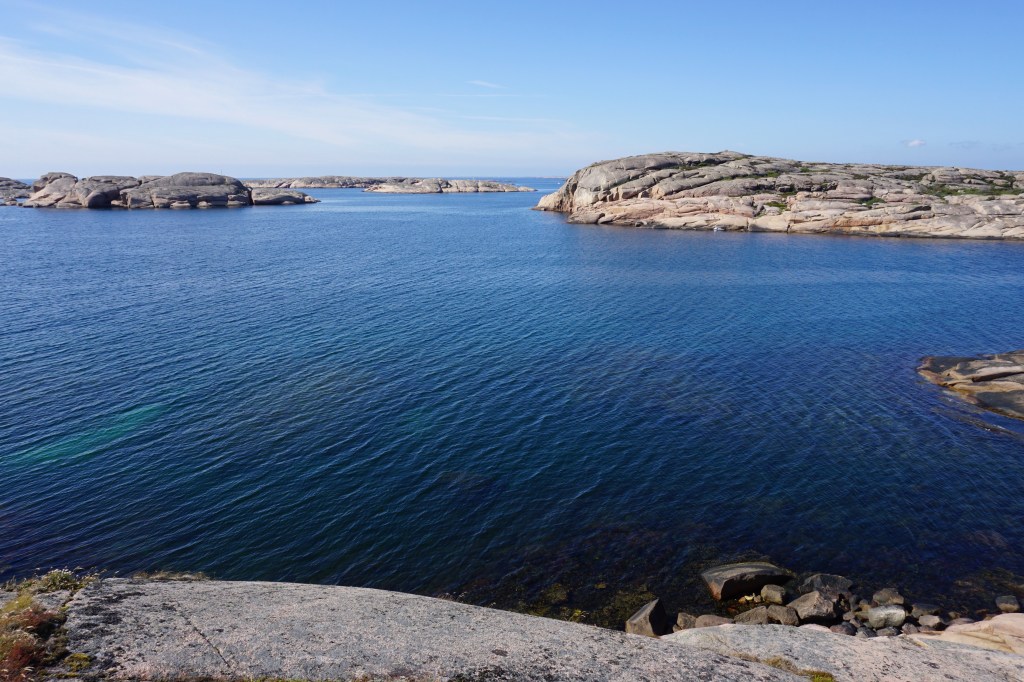
From the island of Gåsö, near Lysekil, where Therese M. Karlsson took Maya Weeks sailing.
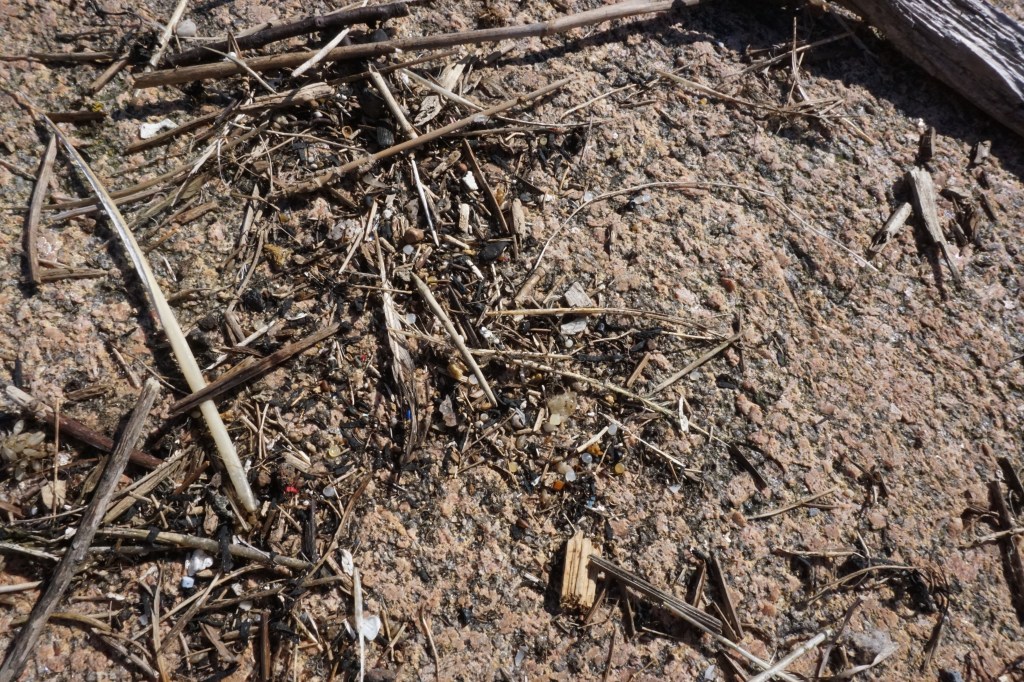
Again, from the island of Gåsö. there are nurdles (small pre-production plastic pellets) matching those produced by a local petrochemical plant mixed in with sticks and feathers on the granite.
****
LP: Over the past few days I have given your Tethers EP a few spins [really enjoy it!], this balance of field recordings, spoken word and drone/angelic soundscapes.
How did you get into making ambient music? & do you have any music on the horizon?
MW: Yes! I have often felt like the page is limiting for poetry. I both love books and the ways they can be linear, and I want to be able to work spatially and not be bounded to linear directionality. And that’s one of the reasons I love performing poetry (and especially hybrid poetry that is really research-heavy). When the pandemic started, I couldn’t perform in-person anymore, and I had relocated back to the rural community I grew up in, where there was an extremely limited arts scene to participate in. So I decided to finally experiment with making a record. I’d dabbled a little in electronic music before; I took a phenomenal course in electronic music while doing my M.F.A. in Poetry at Mills College in Oakland with Maggie Payne where she taught us on a Moog (!), but I’d never devoted any serious time to music. I really loved thinking of the record, rather than the book, as the container for some of my doctoral work on plastic pollution, embodying an ecosystem full of toxicants by using lo-fi field recordings as well as being able to speak to structural origins of this pollution via lyrics. I am very lucky: my friend Andrew Weathers, who I met while we were both studying at Mills, was willing to co-produce the record with me as well as mix and master it for me. I learned so much from collaborating with him, which was a real gift coming from a writing background where it is possible to do so much work alone. And yes! I am working on a new record right now, called Channels, on land stewardship.
****
LP: What else are you working on these days?
I’ve been slightly obsessed with the Icelandic writer, Halldor Laxness, who won the Novel Prize in Literature in 1955 after publishing “Independent People”, which is essentially an epic novel describing everything that could possibly ever happen to sheep and shepherds.
I believe you have entered the realm, beginning as a sheppard and learning about wool production?
MW: Right now some of my other projects are an explicitly materialist ecofeminist poetry chapbook, publishing some of my scholarship, and working toward getting my first flock of sheep. And exactly — I’ve always loved sheep, but many years of plastic pollution research have really catapulted me to this next level in which I want to be participating in producing biodegradable fibers while adding minerals back to aerated soil etc. So much of what I have learned while studying regenerative agriculture, including at trainings such as New Cowgirl Camp and Grazing School of the West, has been profoundly beneficial to how I do and teach art and environmental work, which is wonderful.
LP: Maya, thank you so much for taking the time to chat with Lonningspils today. A big fan of your work and can’t wait to catch whatever comes next.
 lønningspils
Leave a comment