
By Penelope Dieppa.
I overheard a woman behind me describing a Russian film, set entirely in the Hermitage, taking the viewer through centuries of Russian history, done in one shot. She bookended herself: “God I can’t believe I don’t remember the name of it.” I turned, after a small hesitation, and smiled, “Russian Ark! It’s really good.” She and her friends laughed. She thanked me and dug in her purse to add it to her watchlist. The three of them were in the middle of the eternal debate: Tolstoy v. Dostoevsky.
There were a lot of conversations around as everyone settled into their seats, most especially from the trio behind me which included a woman who once worked at a publishing house Knausgård worked with and who 10 years ago became ‘obsessed’ with him. The woman talking about Russian Ark had actually never heard of Knausgård until recently and just began A Time For Everything after the third woman, a #KnausHead of 2 years, recommended it to her. Down the row a man was reading a book which I originally believed to be the signed copy ofThe School of Night we were all given upon entering the venue but a few guys behind him asked him what he was reading (which I never did figure out) and they too began a small momentary friendship. To say the crowd was in high spirits is an understatement, a wonderful mixture of fans, casual readers and newbies. And an interesting debate from those same women behind me as the lights began to dim: Is Knausgård for Men?
****
****
One of the women said that a man in her life thought, simply because of how attractive Knausgård was and how much she enjoyed him, had to be writing erotic literature. The others rebuked the man in absentia, arguing that Knausgård seemed to be rather oriented towards men, the publisher using the Norwegian title Min Kamp as a symbol of its masculinity. The fact that the woman was in book-clubs of majority women was brought up, would a female book-club read My Struggle?
It’s not that I hadn’t had the thought, a man writing about his own life to an almost narcissistic level, but aren’t women stereotyped (at least contemporarily) to be the keepers of diaries? Where they too talk of nothing but themselves and others in relation to themselves. It was interesting, from a distance Knausgård appeared very male-centric. Serious male literature for men about men who think about serious – male – things, but isn’t such a notion obviously patriarchal in origin? I mean here there were three smart women, all of whom liked Knausgård’s books, four if you included me, and online I knew quite a few female readers of his, from a quick estimate more than I know men. Though that might be skewed by my having more female friends.
****
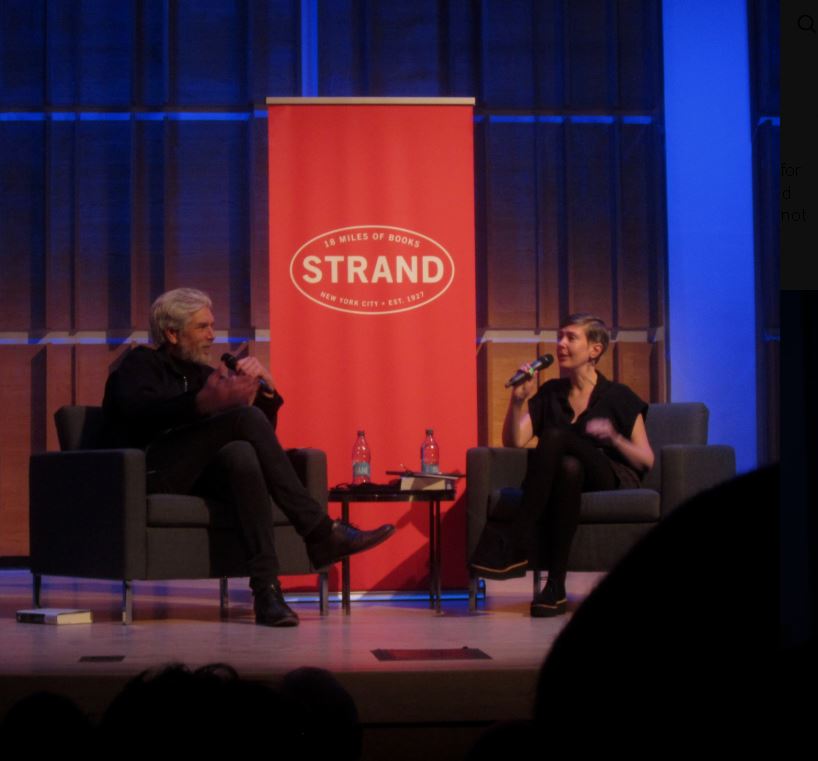
But the time for thinking about gendered literature was over since Walker Iverson from Strand Bookstore (who hosted the event in collaboration with Kaufman Music Center) walked out and introduced us to the January 13th launch event for Knausgård’s newest novel, The School of Night. Along with our speakers: Karl Ove Knausgård, our interviewee, whose My Struggle series was described as a “masterpiece” and Patricia Lockwood, our interviewer, judge for the 2026 Booker Prize and Dylan Thomas Prize winning author of No One Is Talking About This.
Knausgård looked taller from when I saw him last- giving his first and one of few looks into the crowd. Lockwood introduced Knausgård as “Norway’s Elvis” then dismissed herself making a deep cut mention of Kjell Elvis, a Norwegian Elvis impersonator, to the audience’s ignorance. She told us to Google it. She then began a short little explanation of the night’s itinerary, including an elusive phrase “lighting questions” we the audience or her or Knausgård could yell out if the night started to grow dull.
First, before anything at all, Knausgård read the first few pages from The School of Night, which you too should read. Everyone sat on their hands listening and then, returning to his seat, he unceremoniously placed his copy of his own book on the ground. Lockwood’s first question was interesting: she claimed that The Morning Star series (which The School of Night is the fourth entry of seven) is set in a world where death has come alive. Working in the land of the living. She asks if that’s an accurate assessment of the books so far, Knausgård’s response?
A comedically long bout of silence, everyone laughs. He goes on to explain that rather “death is disappearing,” and his real question for the series is investigating what that world would look like. In the world of The Morning Star the boundaries between life and death have become fuzzy and ‘loose’.
The questions continued and a fun dynamic emerged between the bubbly and comedically-confident Lockwood v. the quiet and oh-so-serious Knausgård. They bounced off one another quite beautifully and even though Knausgård is 6’ 4” (or 6′ 3” depending on who you cite) and Lockwood has to be nowhere above 5’ 6”, she took up more space than he did on stage.
They discussed this a bit later in the program, when Lockwood mentions a sequence in The School of Night where Kristian, our protagonist, finds himself at a stage interview in New York, not that dissimilar from the setup of the interview actively happening in front of our very eyes. During which Kristian reveals long-held secrets to the audience and the world’s shock. Lockwood mentions another interview scene in The Morning Star series, when someone runs over a dog during a phone interview. She asked: Are interviews really that terrible?
Knausgård said he has grown to enjoy them, but the fear now comes with the amnesia: he forgets everything he’s said. Lockwood interjected with the same feeling. He doesn’t prepare, he comes to the stage and simply talks, tries to listen, to be in the moment. He cited a similar approach to writing, saying he’s forgotten what is written in his books.
Those ‘lightning questions” were things such as: prawns or cigarettes? Which Knausgård unsurprisingly answered with: cigarettes. Or: Do you want $20? Replied with a: Yes. So Lockwood fishes a $20 bill out of her skirt pocket. Knausgård giving a full vocal performance of the Swedish Birthday song upon request – his deep voice lending itself well.
My favorite question and response came near the end from an audience question, which praised Knausgård’s descriptions of food and asked him if he knew any passages from literature relating to food that he found striking. Knausgård, to more nervous laughter, thought silently for a long while, then said he couldn’t think of any and asked Lockwood for a recommendation. She mentioned a scene in The School of Night where eating a plum with cream is described as a “matchless combination”, asking: “Is it really that good?” Knausgård then gave a minute-long sexually innuendous description of hairy firm small black balls with earthy insides that are still slightly sweet – and cream; dripping and white. At least it’s clear he could write erotic literature.
Finally, as Knausgård and Lockwood stepped off stage Lockwood mouthed to the audience, “Isn’t he so hot?!” There was energy in the room, everyone caught off guard by how quickly and triumphantly the discussion moved, refreshed.
Those last mouthed words of Lockwood and her own veneration for Knausgård reminded me of the three women’s conversation from before: it’s impossible that Knausgård is for men! Lockwood brought up during the interview that in The School of Night but also within the rest of the books of The Morning Star series, “pettiness is the plot.” That the, mostly male, characters’ very small feelings of jealousy or shame or paranoia build to become larger narrative lines. She brings up a moment fromThe Third Realm when, after a man’s wife returns from a trip and kisses him on the cheek, “It incensed [him] immediately.”
I would disagree with Lockwood, as did Knausgård who replied a simple, “No,” though clarifying it wasn’t his intention. I don’t believe it is pettiness that drives Knausgård’s plots, but longing. It’s a longing that underpins all of his writing, a longing for understanding, love, acceptance, safety. Longings that are contradictory at the same moment and which are both equally true and understandable and tangible. There’s a wonderful sense of movement in all of Knausgård’s writings, like the camera work in Sokurov’s Russian Ark, and it’s because of that movement, the feeling that we never leave the action as we cross pages of daily life, those longings become everlastingly present. The same ones repeat from childhood to parenthood, as we’re violently thrown back and forth.
In The Morning Star series a new star has appeared in the sky, but the novels themselves focus on the paranoia of an extra-marital tryst or a child’s headache. Our interpersonal relationships, our small lives, snowflakes in a blizzard of billions, are unimaginably heavy. We are powerless to the fact that the items we own and the people in our family – the emotions those things stir in us – are millions more important than minor changes in astronomical science.
This is what I see in him, as a woman, and maybe this is what draws other women into him. Of course being a 6’ 4” European probably helps, but it’s hardly the draw. I too live my life at the will of my emotions, I live within my own head and my emotions exist somewhere else, both physically and internally thought not within the head I live. The emotions affect my head, who I am, I get lost inside of them and swept away sometimes. Though I never hate them, they are possibly more myself than me.
“I’m writing this for myself. Or rather, ‘my self’. The two words that contain everything we ever were, are and will be.”
 lønningspils
Leave a comment