
By Ava Young-Stoner.
A few weeks ago, I lay glued to my IKEA twin mattress and repeated a behavior quite standard to my time in university: reading a work of classic literature on a deadline of my own creation, in a too-short span of time, also of my own fault. On that particular evening, my online book club was meeting to discuss the first half of Marcel Proust’s In Search of Lost Time (Swann’s Way), a book I had mostly known as a sort of predecessor to the “Norwegian Proust’s” mammoth of a novel, My Struggle.
I am a massive fan of Karl Ove Knausgaard. I could get hung up on ways to qualify this fact by telling you how much I’ve read or about how many lifesize cardboard cutouts I’ve been gifted of the man (one), but perhaps I’ll stray away from the humiliation ritual for now. All the same: big fan.
Therefore, even amidst all of the dazzling prose in Swann’s Way—sentences which would make anyone who wishes to describe themself as a writer or even minorly creatively inclined person bang their head against a wall in defeat—the only time I let myself pause and fight the clock was after reading this excerpt: “Had my parents allowed me, when I read a book, to pay a visit to the country it described, I should have felt that I was making an enormous advance towards the ultimate conquest of truth.” Here, Proust’s thus far unnamed narrator (understood as an image of the author himself) reminisces about his childhood in the French countryside and the different worlds that may exist in literature. Some hundred years after the first publication of these lines about the fictional village of Combray, I sat up in a quiet area of West Berlin and supposed that, in a Proustian sense, I functioned more like a child than not. This was my question: how had Proust so accurately captured the sort of disillusioned idea that I myself had bought into while first encountering Knausgaard’s writing? Moreover, with a trip to Helsinki just days away, why did I still think that going to the Nordics would allow me to tap into something greater within Knausgaard’s bibliography?
I spent about a year and a half reading My Struggle and the backlog of books in the more recent Morgenstjernen/Morning Star series. Over the course of that time, I maxed out my credit card’s small limit to go to Norway. And then I went again. I started taking Norwegian classes online. I moved to Germany because it seemed close enough. I met Knausgaard at a reading and was a total freak about it. And then that happened again. So naturally, when I heard about a Knausgaard opera, I mistakenly thought I had to be there.
****
****
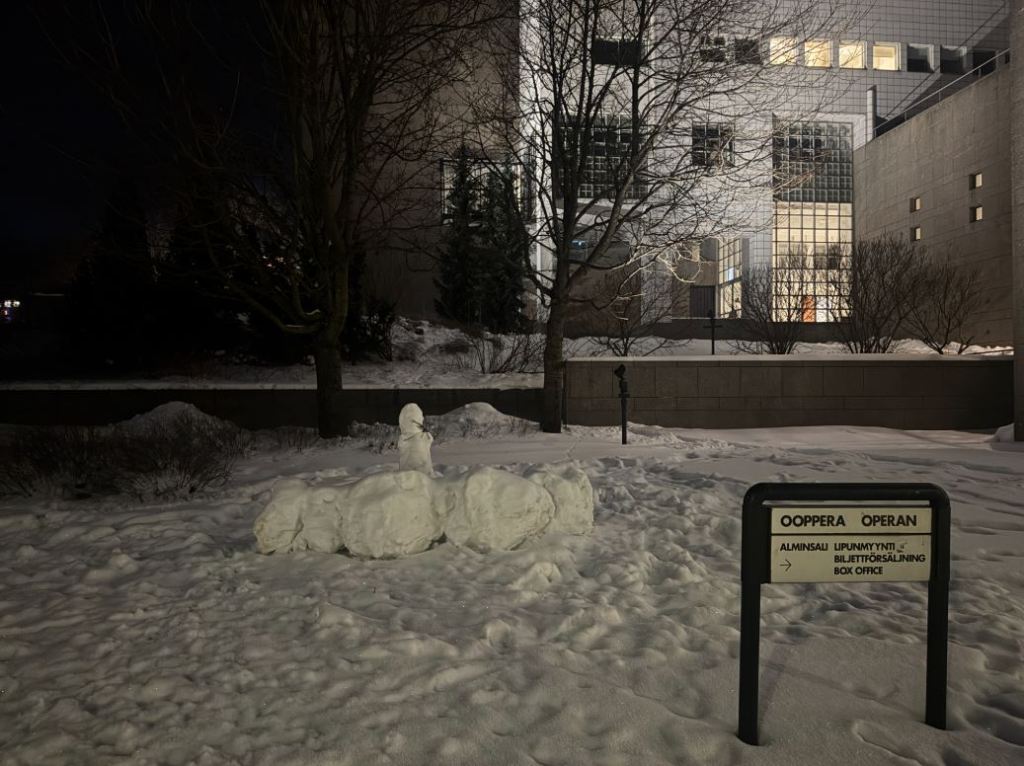
On Friday, January 30, the Finnish National Opera debuted its latest production: Morgonstjärnan, a Swedish-language adaptation of Knausgaard’s 2020 novel. The opera, composed by Sebastian Fagerlund (best known for his work on an operatic adaptation of Ingmar Bergman’s Autumn Sonata) and written by librettist Gunilla Hemming, marked the first time the author’s writing had been adapted to opera. While faithful in many ways to the source text—a 666-page novel about a large cast of contemporary Norwegians experiencing an ominous celestial event—the opera condensed Knausgaard’s expansive story into something at times incohesive and often frustratingly trite.
Whereas Knausgaard’s first major international bestseller, My Struggle, dealt with the inner workings and turmoil of one man clearly rooted in (or at least resigned to) the limitations of human life, The Morning Star makes room for nine narrators and some dozen other named characters to react to the appearance of a new star which overrides the notion that humans, in some scientific capacity, can understand all that exists. After the star arrives, one of the novel’s characters, a doctor, sees a dead man come back to life on the operating table. Another, a priest, sees a man walking around the Bergen airport whom she had just held a funeral for. We read about a major car crash with no casualties. Even a kitten, which one character had certainly thought dead, seemed to have clawed out of its grave. Readers may ponder alongside the characters what it would mean if death were no more?
I suppose the central thesis when reading The Morning Star is that something mysterious has come into the world, and the characters—as relatable to us as they possibly could be—don’t know what to make of it. Kathrine, the above mentioned priest, whose struggle with her religious beliefs is an important aspect of her story, says early in the novel that “When we’re young we think there’s more to come, that this is only the beginning, whereas in fact it’s all there is, and what we have now, and barely even think about, will soon be the only thing we ever had.” The arrival of the star negates her in the most direct sense—of course, in the book’s world, among iPhones and one teenage character’s explicit reference to Ariana Grande, a new star shows that everything is not just ‘all there is.’
Both the opera and the novel take place over two days, though the opera reduces the number of central characters and condenses their story arcs into oddly placed sequences of events that seem to point to a conclusion manufactured completely outside of what happens in the text. For example, though the plot of The Morning Star is not particularly complex, the context of a priest going to an airport, overseeing a funeral, ignoring her husband, and finding out she’s pregnant are all interesting when one considers her dwindling faith and unwillingness to comment on the Church of Norway’s stance on what happens after death. In the opera, only the bones of this woman, Kathrine’s, story remain. She walks in an airport. She is stressed. She doesn’t want to see her husband. Why? It does not matter. Oh, and also there is a guy with a scary mask and shoes that look like hooves whom we later learn she thought was dead. Perhaps the slow burn that takes place over 600+ pages is not compatible with the format of contemporary opera, but the characters Hemming chose to keep in the libretto seem no more particularly important than those she cut.
I wondered while watching the opera if I had been plagued by having read the book. Would it have been a more enjoyable experience if I weren’t putting character names to faces before a word had even been sung? Would I be more or less attuned to the large projection of an ablaze, grey-ish white star growing in size at the back of the stage throughout the performance? It’s impossible to answer these questions, but there were so many points of confusion even with my background knowledge that I decided not to bother with the hypothetical after the show had ended.
When I arrived at the opera house, the audience (capacity of 1,350) was mostly full, and I heard a healthy mix of Finnish, Swedish, English, and occasionally French being spoken around me. From my seat in the second row, I had an excellent view of the stage, which, at the top of the show, presented a large screen playing flight information for the Bergen airport and various flashing videos alternating between news reports on environmental collapse and advertisements full of corporate lingo about teambuilding, entrepreneurship, and things of that sort.
****
****
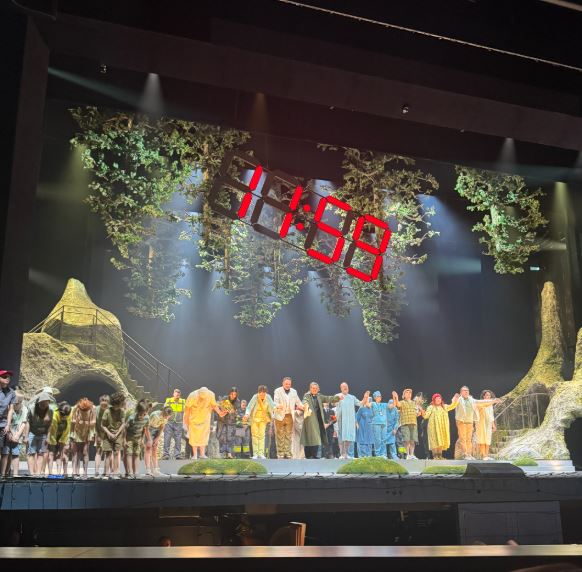
At about 15 minutes until the performance began, the stage itself was mostly empty, though two children sat downstage and gazed out at the audience in a trance-like state. As the time moved closer to eight, more and more actors filled the stage playing as various airport employees or travelers. Two large rock formations with built-in staircases served as the primary setpieces, and once the show began, a circular conveyor belt became the primary way in which the storyline progressed through its various narrators. One scene would happen (say Kathrine calling her husband frantically), and then she may walk on the belt while another character rides behind her, introducing a new course of action.
The staging was certainly effective, and as a reader, I felt few qualms about seeing The Morning Star’s characters brought to life in the chosen cast members. The singing was lovely; the orchestra, of course, talented; and the costuming, often excitingly frightening. Besides the dead man, whom Kathrine sees milling about the airport (who reappears in the fourth book in The Morning Star series, The School of Night), the next most important creepy figure was a sort of bird-human hybrid, which Turid, a woman who works in a psychiatric hospital, sees in the woods while looking for a lost patient. I’m unsure if the creature’s presence within the opera held as much weight as it did in the book—I saw it more as a novelty and product of a great seamstress than of an ominous hint about the devil—but it at least provided a distraction from the divergent themes of the book versus the opera.
Other than the rock formations, ever-growing morning star, and various trees descending from the ceiling throughout the show, the most visible (and perhaps thematically important) set piece was a suspended digital clock which only provided legible numbers at the very end of the night. After all was said and done in the show—a weird affair, death seeming to cease, a married couple vowing to try their best to stay together, one man killing the cat which in the book never actually dies, and a few other hodgepodge scenes—the children from the top of the show band together wearing all yellow at the front of the stage while the adults remain upstage physically acting through their various dramas. Eventually, Jostein, an arts journalist who wishes to cover crime news and who has just seemed to overcome his own death and rescue his son from a dreamlike, underworld state, climbs atop a car and sings about the world changing. The most memorable lyrics of the entire show, something like “Everything speaks to us, but we do not answer,” is sung by the whole cast, and as quoted from the playbill pamphlet I paid seven Euros for “[the children] bring a message of hope, change, and possibility of a better future” as the glowing red clock strikes 11:59.
It would be naive of me to expect some perfect adaptation of Knausgaard to the stage, but I hadn’t quite expected a book which ends with a ~60 page essay about death and the human penchant for despising irrationality to be reduced to something so forgettable in operatic form. Whereas one of the primary conceits, I thought, of the book was that human life and fabrications of religious belief seemed to rely on searching for a deeper meaning that modern scientific discovery has affirmed was never really there, the opera’s take that “everything speaks to us” introduced an optimism that felt both unsubstantiated by the events of the show and of its source text. While the new star is bright and mysterious, its presence never indicated peace or really anything remotely positive; even the absence of death was unnerving, not something to be thankful for.

 lønningspils
Leave a comment