
By Gregory Conway.
Jenna Grace Sciuto Ph.D. is scholar focused on colonialism’s lingering impacts on identity, intimacy, and family dynamics across Icelandic, US Southern, and Caribbean literatures (& more!). I came across their book Intersecting Worlds: Colonial Liminality in US Southern and Icelandic Literatures and was absolutely blown away by the book’s originality and depth of research. She is a Professor of English at Massachusetts College of Liberal Arts and holds a Ph.D. from Northeastern University. Along with Haukur Ingvarsson, Jenna co-founded the Nordic Faulkner Studies Network which connects Faulkner scholars in Nordic countries alongside global scholars connecting Faulkner’s work to the Nordics.
****
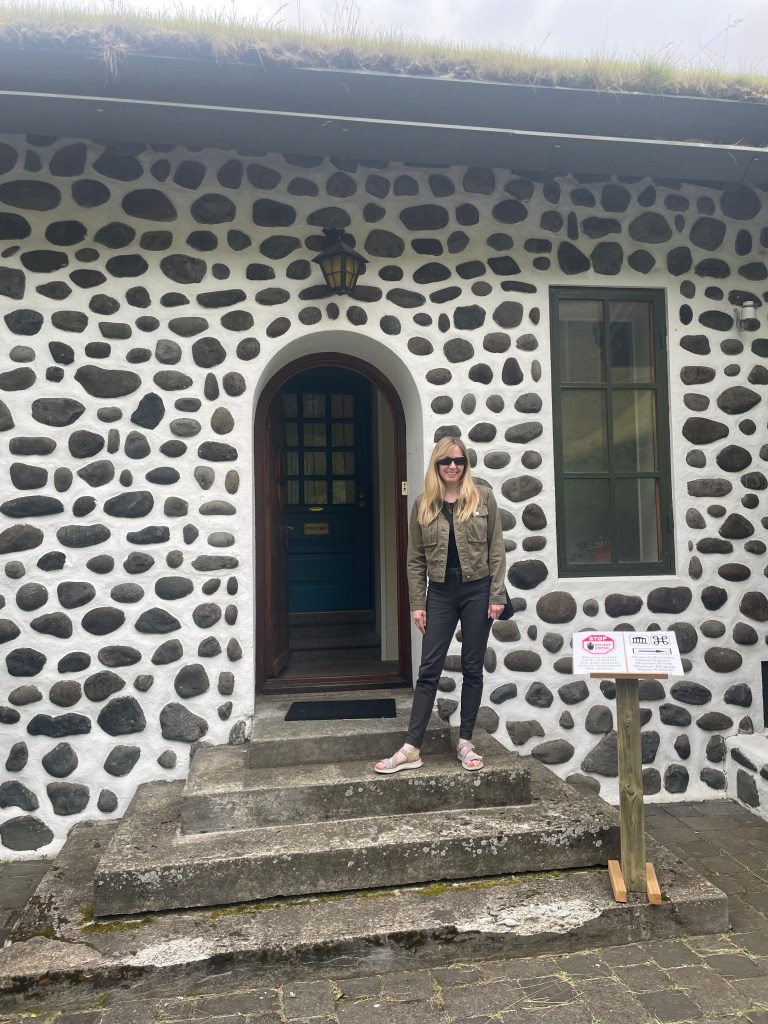
Jenna Grace Sciuto at Skriðuklaustur, the former home of the author Gunnar Gunnarsson.
****
LP: Hey! Thanks for joining Lonningspils for a chat today. In Peterborough we are gearing up for the coldest day of the past few years (-31c).
How is Massachusetts today?
JGS: Oh wow, that’s incredibly cold! It is snowy in the Berkshires today, but also above freezing for the first day this week, so I will take it. And thank you for having me. I’m excited to be here.
LP: Though we will certainly touch on your wonderful book Intersecting Worlds, which I thoroughly enjoyed reading over the holidays – I wanted to start off elsewhere. Can you tell me about starting the Nordic Faulkner Studies Network? & more broadly about how you began to connect Icelandic Literature with Literature of the US South?
JGS: Sure, the Nordic Faulkner Studies Network is a project I started with my frequent collaborator at the University of Iceland, Haukur Ingvarsson, poet, novelist, and cultural historian. The network connects Faulkner scholars living and working in Nordic countries with those around the world, like myself here in the States, who are researching Faulkner in relation to Nordic literatures, cultures, and histories. This semester, with the help of a student intern, we are revamping our website to spotlight resources, events, and scholarship, as well as some images of Nordic language editions of Faulkner’s works from my time researching in the Faulkner collection at UVA.
And I’ve always been interested in themes of liminality, identity, interpersonal dynamics and complex colonial histories in my research, but my first book, Policing Intimacy, focused on these themes from the perspective of the US South in conversation with the Caribbean. However, during the pandemic, I began to read lots of Icelandic literature for fun, and since literature professors can’t really turn off our analytical brains, I started thinking about how some of these themes might play out differently but relatedly in northern spaces. How might our thinking about global histories of colonialism shift when we consider not only southern spaces, but a Far North location like Iceland–disrupting our typical configurations of space and power.
With Iceland’s history as a dependency of Denmark that also endured a US military presence for generations, these comparisons were striking to me. And early on, the work of Icelandic anthropologist Kristín Loftsdóttir was very helpful for me in recognizing how Iceland sought to position itself as culturally White and European, and not aligned with other dependent spaces. I became very interest in these tensions and how they might relate back to the colonial liminality of the US South.
LP: Excited to see the revamped website & hope to see something happen up here in Canada one day with the Nordic Faulkner Studies Network! I became really drawn to your work for mixing the Nordics with colonial study, I’m an Indigenous Canadian and grew up in a First Nations Reserve and feel there are so many parallels to the Nordics. Part of my love for Nordic Literature is the ability to learn about myself and my own country through another lens… so it was shocking and amazing to stumble across your book!
JGS: That’s a very interesting connection. I’d love to learn more about and think more about Canada’s relationship here too!
****
LP: You mention the US Military presence in Iceland – I wanted to share a piece of historical information included in your book with our readers; Iceland endured a US Military presence from 1941-2006 & even more troubling to learn was the historical agreement between nations that no Black soldiers would be stationed in Iceland. I personally had no knowledge of this occupation and military segregation until I encountered Halldor Laxness and learned more about Iceland. There really is a deep and thorough connection between the US and Iceland as intersecting worlds, not just in literary similarities.
Your work feels increasingly important as we see the tension between the US and Greenland develop in the New Year. Are you planning to work further in this direction now that the book has finished and Nordic-American intersections seem more relevant than ever?
JGS: Yes, I’m currently embarking on a new project that is structured by these interests but also breaks new ground for me. In Northern Spaces and the Edges of the Self, I plan to explore women writing about relationships with self, others, and the natural world from Nordic and Celtic peripheral spaces, but it will be a hybrid work, combining scholarly sections with personal narratives, focusing on my experience as a US-based writer who spends my summers living and writing in Iceland. Women’s self-representations and intersectional identities will form the heart of the book, which I’ll analyze with an awareness of culturally constructed nature of lived experiences. More specfically, I’m looking at Shetland, Orkney, the Faroe Islands, Iceland, Greenland, the Finnish archipelago, and the North Sea coast of Denmark, and I’ve applied a couple grants to get me back to Iceland, but also maybe to the Faroe Islands and Greenland. The prospect of doing this work as a US-based academic in Greenland has of course totally changed over the last month, so I need to rethink my approach there. I plan to work within feminist theory, cultural geography, and postcolonial and Indigenous studies, but I think the recent development highlight even more how deeply the inheritance of colonial histories still matter to this very moment.
LP: Exciting! I’d love to see more work in these fields, particularly the Faroe Islands, other than Kim Simonsen’s poetry book with Deep Vellum last year & Sólrún Michelsen’s upcoming book with Transit, books from the Faroe Islands sadly don’t make it to English translation that often.
JGS: Agree! I’m very excited to finally get my hands on Sólrún Michelsen’s book this spring!
****
****
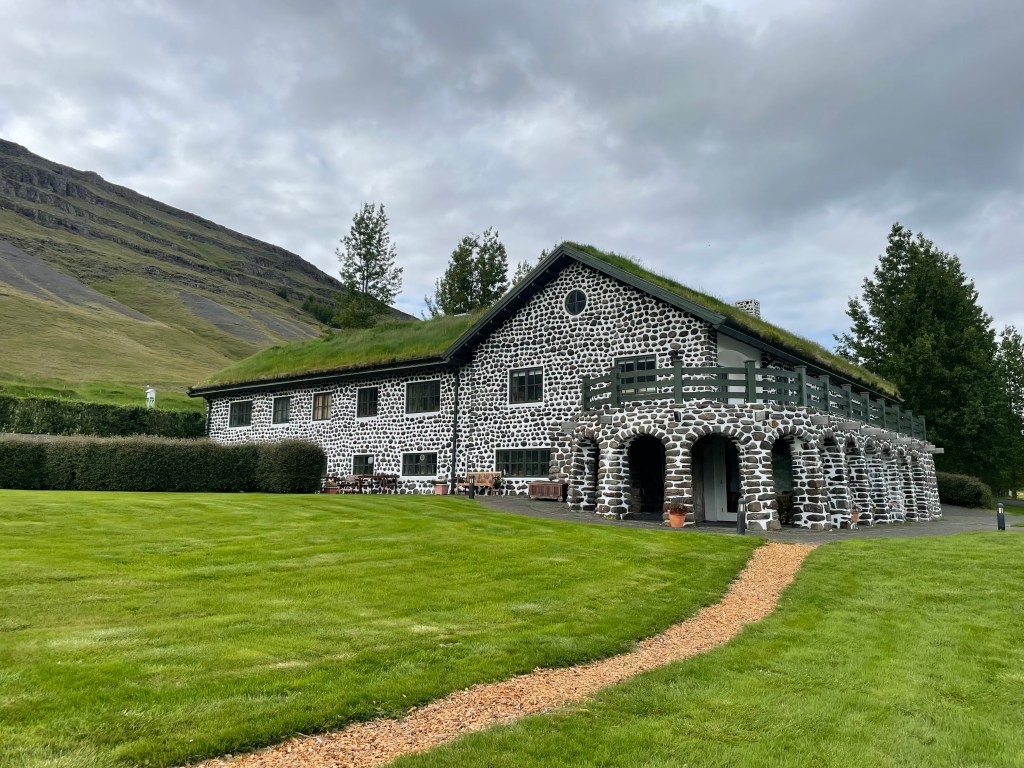
LP: On spending summers in Iceland, I believe you had the opportunity to do a residency at Skriðuklaustur Which was Gunnar Gunnarsson’s homestead when he moved back to Iceland (though “homestead” may be better described as a mansion, or even better as a touching art piece, either way its one of the most picturesque things I’ve ever seen).
What was it like to spend some time and get some research done on site?
JGS: Writing at Skriðuklaustur was truly an amazing experience! I highly recommend to other writers, researchers, artists. I’ll admit that I’ve mostly lived in towns and cities–so it was an adjustment at first to live in such a remote place without transportation. But once I sunk more fully into the experience, I got into a rhythm of writing in the mornings, exploring the unique landscape of the Fljótsdalur Valley in the afternoon, and returning to read, knit, and watch Icelandic series in the evenings. One thing I love about that museum is that it not only foregrounds Gunnarsson’s life but really centers the literature itself with poignant quotes from the novels adorning the walls. It’s a museum, but yet, as you have it’s a touching piece of art itself, and one that gives a place of privilege to writing and language.
****
LP: To enter conversation about your book, I wanted to start in a similar way to how your book starts – with William Faulkner visiting Iceland. In 1955 Faulkner visited Iceland for 5 days in an effort to broadcast US Cultural achievement; Faulkner had recently won the Nobel Prize in Literature and there was already some buzz in the air that Laxness may join him soon.
In Halldor Gudmundsson’s (very good) biography of Halldor Laxness he says (on p. 337): Laxness dismissed Faulkner in 1951 by writing “He found Faulkner, on the other hand, too pinched, deliberate, complicated”. With the knowledge of how Laxness heavily downplayed his influences (a great example of this is him downplaying the influence of Knut Hamsun yet writing Independent People which is really in conversation with Growth Of The Soil), I feel this quote in the book can almost be read as a sign of endearment about Faulkner from Halldor. Though they never did meet on Faulkner’s trip to Iceland, they two do share quite a lot in their literature.
I find the connection between Faulkner and Laxness to be a key theme throughout your book and something I have been talking to with quite a few other people since finding your work – mentioning the connection I have been getting a lot of responses along the lines of “ohhhh that makes so much sense” – How did you initially connect these two writers?
JGS: Good point about the downplayed connection to Hamsun. I definitely think there is something to this connection–as my book likely shows. And here I definitely have to credit my collaborator Haukur with inspiring my to think through it. He’s written extensively on both writers and knowing about my work linking gender, sexuality, and spaces with complex colonial histories together, he encouraged me to read Salka Valka (before Philip Roughton’s lovely new translation had made its first appearance). I’m grateful for this urging, as my chapter on that novel might be my favorite. I’m also drawn to the way that both Faulkner and Laxness emphasize themes and content through the form and aesthetics of their books. For instance, I explore this parallel with the repetition of racialized words and phrases in scenes from Laxness’s The Atom Station, alongside Faulkner’s Absalom, Absalom! I’m intrigued by the way that small, aesthetic features, when repeated across the novels, demonstrate how language can be used to demarcate Whiteness and even dehumanize those who are different, and in such divergent contexts as Iceland during the Cold War and the US South in the late 19th and early 20th centuries.
LP: I recently read Laxness’s Paradise Reclaimed with this repitition in mind and the part in your book about Icelanders historical Whiteness. It really brings new light to these scenes where Icelanders over-and-over relay their entire histories and “pure” lineage while Danish characters look down at the practice. Before reading this in your book I kind of just blindly took it as an ode to the way this repetition happens in the Sagas where characters constant relay their lineage, there is more to it.
To stick on Laxness, and particularly Salka Valka – which I often call The Greatest Novel Of All Time. While reading Chapter 3 of your book in the section “DEPICTIONS OF SEXUAL VIOLENCE TOWARDS YOUNG GIRLS IN THE NOVELS” I paused and ended up re-reading the sections of Halldor Laxness’s Salka Valka, where Salka is assaulted by Steinþór. Laxness delivers one of the coldest lines in Nordic literature – “Such as Salka Valka’s first personal experience of love”. Salka Valka, to me, is one of the most insightful novels regarding sexual assault in the history of Nordic Lit, we see this moment with Steinþór leech into everything in her life: her reputation, her future relationships and self-image.
Salka Valka is often reduced in my own literary circles as “a novel about fish” or “a novel about socialism and labour rights” & conversation doesn’t often touch on the sexual assault featured in Laxness’s work – I found this echoed in another section of your book where it states “there is little feminist criticism in English on Laxness to date” (p.88).
Do you think there is a reason why Salka Valka has been more oft approached as a novel about economics of the fish industry, labour relations and rural Icelandic politics rather than from a feminist perspective or lens of gendered violence?
JGS: I’m so glad to hear that my work brought to light some different aspects. I haven’t gotten to Paradise Reclaimed yet, so I may have to bump it up in my queue! And yes, this is a great question… and I’m not really sure. In my view the subject positions of the writers might come into play. I’m thinking about how the work of the other writer I discuss in that chapter, Carson McCullers, a queer southern woman, is commonly read through the lens of gender and sexuality, whereas Laxness, and Icelandic man, is more frequently read through an economic or socio-political lens (and of course, there is a rich history of scholarship in Icelandic engaging more so with these themes, but the point stands for the English criticism). I’m thinking this might also connect to a piece Haukur and I are co-writing about Faulkner’s Sanctuary and Laxness’s Salka Valka–both published in 1931! I’m very interested in how the two female protagonists, Salka and Temple Drake, subvert the gender norms of their society in divergent but comparable ways, but at the same time, in the article we address how Faulkner and Laxness, White, male writers of their times and places, at the same time employ various strategies to contain these disruptive female figures, from their sexualizing descriptions of their young bodies to their elliptical descriptions masking the scenes of violence. So while writers identities might impact their relationship to the subject matter, at the same time perhaps readers and critics might import certain frameworks as a result of these factors too, as in the case of Salka Valka with English-language scholarship.
****
LP: I wanted to pick your brain on an innovative piece of translation I read last November which really connects the Nordics with the American South in a unique way; since you may be in a perfect position to makes heads/tails of it – The book is called The Calf by Leif Høghaug, an experimental Norwegian literary fiction book put out by Fum d’Estampa Press. The translator, David M. Smith, is from the American South, Atlanta. The original is written in this rural Norwegian dialect (hadelandsk) and the approach to translating it was to make the English edition appear in a rural Southern / Appalachian dialect, it was somehow a great success and worked perfectly as a translation.
Though Icelandic does not have the same dialect systems as Norwegian, do you think that an Icelandic translation into a dialect of the American South could ever be successful?
JGS: So this is fascinating to me. I hadn’t heard of The Calf and definitely need to read the book now! I find Icelandic literature so compelling with such universal appeal that I’d love to see more of it translated generally. In terms of using American Southern dialect–super interesting–I believe that choice should reflect something essential within the content of the original novel, as sounds like is the case with The Calf. I can’t off the top of my head think of any Icelandic novels in which this would be the case, but perhaps someone with a deeper knowledge might have ideas where the content might align with the form in this way. I’ll think about this more once I’ve read the book too!
****
****
LP: Though the big names like Laxness, Carson McCullers, Gudburger Bergsson & Faulkner are highlights to your book- there are really special and under-read Icelandic books discussed insightfully. I wanted to make reference to two of them here, so people could check them out – The Lodger by Svava Jakobsdóttir which is truly Lynchian & the hard-to-track-down-a-copy masterpiece Angels of the Universe by Einar Már Guðmundsson.
For our readers (& myself) who are likely more familiar with Icelandic Literature than literature of the American South? Where do you think is a good spot to start with Literature from the US South? Either inside of, or outside of, the big names.
JGS: I believe I saw that there will be a new translation of some of Svava’s stories coming out this year too! Excited for that.
Hmm… yes, as his presence in this interview demonstrates, I believe William Faulkner would indeed be a great author to begin with. I start my students with the experimental, historically-inflected The Sound and the Fury, but I could also see A Light in August or As I Lay Dying as good entry points to his work. I’m also a big fan of Jesmyn Ward’s work, and I might start with her novel Salvage the Bones, as well as Carson McCuller’s The Heart is a Lonely Hunter or The Member of the Wedding. For those interested in the connection to Denmark and Danish colonialism, I’d expand to a hemispheric American frame to read Caribbean American writer Tiphanie Yanique’s Land of Love and Drowning, about an intergenerational family in St. Thomas in the Danish West Indies, as it transitions to part of the US Virgin Islands. She might not be consider “southern”, but Nella Larsen spent significant time in the US South (as well as Denmark), and her novel Quicksand speaks to those experience. But, yes, if any readers are interested in more specific, tailored recommendations, I invite them to reach out to me as well. I’m a total nerd and love to exchange book recommendations with folks!
LP: So exciting, I personally will be taking you up on some of these recs as I enter a Faulkner deep-dive this spring… Though I have made a chaotic and possibly poor decision of first starting with The Wild Palms. Thank you so so much for taking the time to chat with me today, I really enjoyed reading your book and feel it has enhanced my reading of Laxness. Enjoy the rest of your day & keep in touch, I’m excited to follow all your future work!
JGS: That’s a bold but definitely not bad choice! Thank you for this opportunity, and I’m looking forward to checking out The Calf and also Paradise Reclaimed soon.
****
****
Jenna’s wonderful book Intersecting Worlds: Colonial Liminality in US Southern and Icelandic Literatures, is available here.
This interview has been edited for length and clarity, all photos are courtesy of Jenna.
 lønningspils
Leave a comment