
By Gregory Conway.
Geoffrey D. Morrison is a writer, language teacher, trade unionist and long-sentence-enjoyer who lives and works in British Columbia. I really enjoyed his first novel Falling Hour (2023) & when I recently learned he’s been in the process of learning Norwegian; I had to set aside a late February evening to chat about Nordic Literature, UFOs, Mauro Javier Cárdenas, Coach House Books, the Vancouver Public LIbrary, reading Vigdis Hjorth in Norwegian and more. His upcoming novel The Coffin of Honey is available here.
****
LP: Hey Geoffrey, thanks for joining me for a chat for Lonningspils. How is your day going over in BC? We are really back into feeling like winter here in Ontario after a brief respite.
GDM: This has been a fairly typical day for me teaching English at a language school. Now I’m back home. The sun is out today which we always badly need here. But I hate to admit that it is definitely starting to feel like spring. The crocuses are out!
LP: I first found your books through your publisher, Coach House Books; My friend, Lindsay, used to work for the press and gave me Falling Hour (2023) as a very appropriate gift a couple years back when I was really obsessed with Type Books’s plotless fiction shelves.
How have you found working with Coach House as you return to them for your second novel, which is relatively more “plot heavy?”?
GDM: That’s so lovely to hear that Lindsay gave you a copy of Falling Hour! I was quite honoured when I found out that Type had put me in the “plotless fiction” section because when I lived in Toronto for two years (2014-16) I always admired their selection and their sensibilities.
I really love working with Coach House and I am so grateful to them for taking a chance on me both for a book where, quite willfully, nothing happened, and now a book where things actually kind of do. The truth is that the ostensibly “experimental” structure of Falling Hour came very naturally to me, and in many ways it’s The Coffin of Honey that represents an experiment for me artistically. I think what links them is the idea that forward momentum can come from poetic association as well as (or instead of) sequences of actions and events. Only this time the poetic associations are happening for multiple characters instead of a single narrator-character.
LP: Speaking of forward momentum, it can also kind of come from structure in a way; can you tell me a little bit about the workshop “The Sentence That Never Ends”, which you ran at the Central Library in Vancouver?
With your first novel being blurbed by Mauro Javier Cardenas (one of my favourite Sentence Never Enders™)- do you read a lot of long sentence novelists and find inspiration in that kind of work? Ie. Fosse, Krasznahorkai, Bernhard, Ellman, Enard etc.
GDM: Oh man, that workshop was such a delight. I’ve actually been given a chance to do it again online later this week! What I basically wanted to emphasize to participants was that this seemingly intimidating or unapproachable technique, so often associated with difficult late Modernists, is actually very welcoming and open for anybody to try, no matter whether they’re experienced writers or fiction or simply people who enjoy keeping a private journal. I use a series of examples (and actually Mauro is one of them, or specifically the diagrams he uses to keep track of sentences that range across pages) and I go over the basic sentence mechanics know-how that can help demystify the process. I was so happy with the response. One participant told me, “I found out I’m funny!” Another person told me she used the technique to explore the motivations of a character she’s developing. It hadn’t even really occurred to me that it could be used that way but of course it can.
I do love the Long Sentencers and have found them very enabling for me as a writer. To your list I have to add Marguerite Young, who I think found one of the most beautiful solutions to the organizational challenges of the long sentence via something called a “resumptive modifier” (ie new clauses kind of “pick up” where previous ones left off, which Young does so deftly in a way that makes it much more than just repetition) and Gerald Murnane, whose long sentences often very boldly layer on adjectival clauses without any commas, resulting in something both elegant and thrillingly alien. But more than anything I have this pet belief that it’s contemporary English writing that’s the weirdo, and if you go back to older forms of English, or to perfectly acceptable literary sentences in many other languages (Spanish, French, and Portuguese coming quickest to mind), the long sentence is if anything the norm. I started out as a huge fan of 17th-century writers like Thomas Browne, and he opens many doors in that regard (including to Borges, also a Browne fan).
LP: Wait, online next week? Can there be a branch of the Vancouver Public Library opened up in Ontario real quick??
There was a period where I was reading a lot of Krasznahorkai that I found paragraph and sentence breaks extremely disruptive and kind of annoying, which was a really interesting period for me as a reader; which may have actually boiled down to me being addicted to my cell phone and any chapter break feels like a perfect time to Check All My Apps where uninterrupted prose really lets me focus and get completely immersed.
GDM: Yes, haha, let a hundred VPLs bloom. I know what you mean about paragraph breaks being disruptive; there’s something almost therapeutic about getting caught up in the unending flow of ideas and associations. It certainly works that way for me as a writer, too. My good friend Matthew Tomkinson, who is both a writer and a composer/musician, said that if my writing was a genre it would be drone. I totally agreed. There’s something calming about it, and I think the more that reading feels like a willful battle against the 21st-century attention economy, the truer that is.
LP: Oh that makes so much sense. I’ve been really diving hard on ambient and drone music recently, winter is just perfect for it. We are interviewing on the day Eliane Radigue passed, an ambient legend, and the connection between ambient/drone and uninterrupted prose makes so much sense and is a perfect thing to think about today.
I wanted to ask about language learning, on top of having a substack which is entirely in Spanish (?!), you do language teaching as a career as well. Did you grow up with multiple languages being spoken or how did you come to this part of your life? I have a slight hunch that there may be less demand for Norwegian language classes in BC than other language options…
GDM: I kind of did grow up with multiple languages being spoken at home, but not in a way that was always obvious even to me. My mother is from Aberdeen in Northeast Scotland; she came to Canada as a nanny in the 1980s. Growing up she spoke Doric, which is Northeast Scots. The politics of language being what they are, many people have not always thought of Scots as being a separate language from English, even though they evolved quite separately for hundreds of years and are by no means always mutually intelligible. My mother sometimes had to translate her father, who grew up in the countryside, for her mother, who grew up in the town. And she genuinely did put “Doric” as my “language spoken at home” on my kindergarten intake form. So I think this exposure was enough to make me aware of and interested in languages writ large. It has inexorably become a huge, almost ridiculous obsession, but one that makes sense in hindsight. I am constantly clearing out the language learning sections of my local used bookstores.
I’ve loved Spanish for a very long time and committed to it more rigorously about six years ago, basically just to read writers I loved. At university I studied English literature, but I was drawn specifically to its Medieval and Early Modern forms, which are more obviously different in language (and incidentally closer to languages like Norwegian). Norwegian is a relatively new language of study for me but it’s been so much fun. I take classes via the Scandinavian Cultural Centre here. Our classes are small but lively. I have no family connection to the language (beyond that my mother’s Doric sometimes has surprising Norwegian cognates; in Doric a girl is a “quine”; not unlike “kvinne”) but I have felt very welcomed.
LP: I like getting the little tidbits of information about languages such as that Doric-Norwegian connection. It also comes through in writing, like pg. 222 where we get the line “In Farsi you “cut off” the phone instead of hanging it up, which is no less executionary”, even though I’ll never learn Farsi- I love learning these tidbits.
I know you made your way through Long Live The Posthorn by Vigdis Hjorth in Norwegian Bokmal last year, but could you go more into your own experience with Norwegian literature, including in translation? Was there a specific author or writer who inspired you to start learning the language? For example my own very feeble and mostly failed attempts to learn Norwegian stemmed from badly wanting to read untranslated Dag Solstad.
GDM: I am glad you like the language facts in the book! Because this is such an obsession for me I fear (actually no, I know) that I will one day write a book that is told entirely through etymologies.
I was partly interested in Scandinavia as a young person because its social democratic history is an inevitable reference point for socialists of many stripes, and I am very socialist. Also, I don’t know if you feel this too but Robinson Davies once said that Canadian literature made more sense if the country was understood as pseudo-Scandinavian (cold, petrostate, constitutional monarchy). But my real inciting incident was having friends, Jordan and Heidi, who are very literary and live in Norway. Jordan is from Saskatchewan and Heidi is from Drammen. Jordan gave me a translated collection of Kjell Askilden stories a few years ago which was my first brush with contemporary Norwegian literature. I loved the stories and found them uncanny in how much they reminded me of life and people here. Tense and grudge-filled trips to cabins on inlets, things like that. My wife and I went to see our friends last year, and I began to study Norwegian in preparation for the trip. Hjorth’s book was one that Jordan strongly recommended to me when we were at a bookshop in Bergen, so I bought it in Norwegian and made it my goal to learn the language well enough to read it.
What you’re saying about untranslated Solstad reminds me of a wonderful Lydia Davis essay where she explains how she tasked herself with learning Norwegian for precisely the same reason. She badly wanted to read his untranslated genealogical novel, and she did so in a way that I am awed by. No dictionaries!!! She took a few introductory classes, read some kid’s books and comics, and then went straight to Solstad, simply making lists of words she didn’t understand until, with enough repetition, she did. The essay is in her Essays Two and is simply called “Learning Bokmål by Reading Dag Solstad’s Telemark Novel.” I don’t think I could do it that way but I understand her reasoning.
****
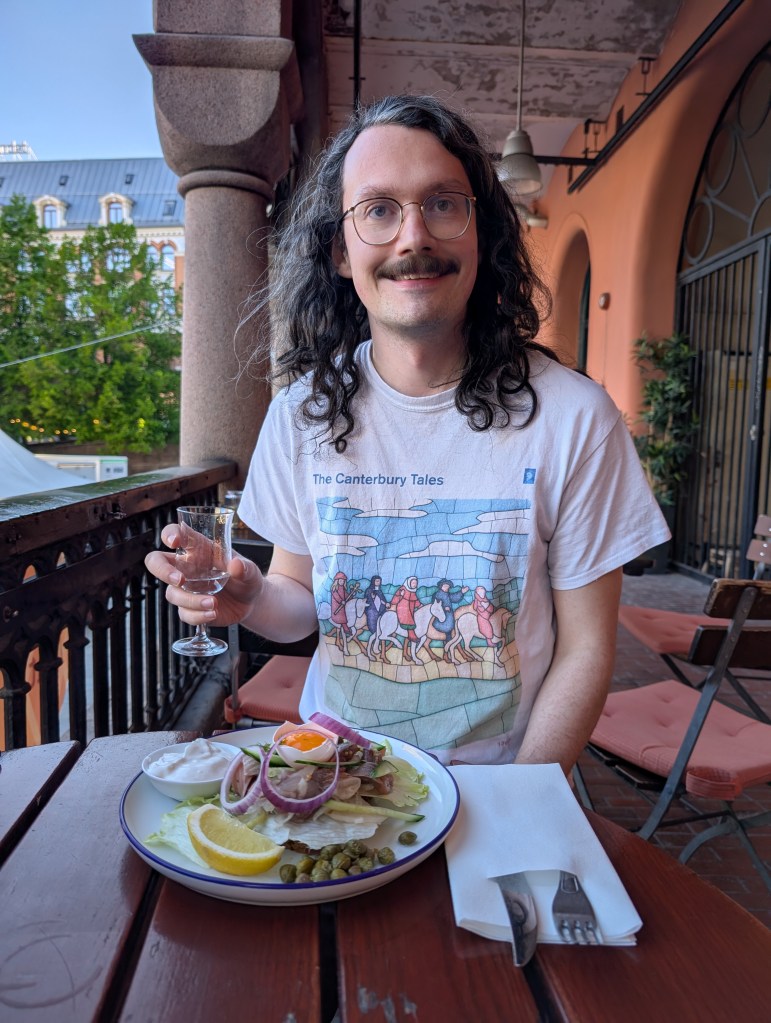
Photo courtesy of Geoffrey D. Morrison: “I am having the greatest smørrebrød of my life at Fyret mat & Drikke in Oslo, right across from the national Arbeiderpartiet headquarters.”
****
LP: To get into The Coffin Of Honey it makes sense to start with the title. I wanted to ask how you connected with the symbol of Alexander The Great being embalmed in honey when he died at age 32? As a 32 year old man I have been thinking about this symbol quite a bit since reading your book; the coffin of honey symbol has been making me think about a David Foster Wallace-esque entertainment paralysis, which isn’t necessarily the same way it is a symbol in your novel.
I’m going to share a passage here that’s really stuck with me, for my fellow 32 year olds to enjoy:
“I am thirty-two and I have been laid low by elegant brutality, and my body will become a crystal shard as hard and clear as this diving bell that showed me things I do not know what to do with. I am slipping into present tense”.
GDM: I think I was primed for Alexander to play some symbolic role in the book because I was interested in the premodern interconnectedness of the so-called East and West. And I’d known about another, parallel image of Alexander in a diving bell ever since I was a little kid obsessively reading about submarines. But to the best of my recollection I realized that his coffin of honey might be central to my whole project almost in real time as I was writing “The Bell Letter,” the section of the book you quote from. I was 30 at the time I was writing that section, and imagined that I might be 32 when I was finished the book. I am 35 now. Hva kan man gjøre?
I think your connecting the image to entertainment paralysis is really on point. The Bell Letterist, a character who is given the chance to learn more about the alien visitors than almost anyone else, keeps returning to this idea of being embalmed or buried in sweetness. The Bell Letterist’s sweetness is an intellectual hedonism: the thrill and the transport of contemplating beautiful ideas, getting lost in a mystery. They feel simultaneously compelled and trapped by this urge, as if they have gotten stuck on a certain dialectical step. Maybe Marx would call it, by no means unsympathetically, “the sigh of an oppressed creature.” In fact, almost all of the characters who are given the chance to travel with the alien visitors are similarly frustrated daydreamers, living in unequal societies that thwart their basic aspirations to dignity and justice. Hence the ambivalence of the image of entombment in honey, being sealed up in something beautiful that appears (but only appears) to keep you alive.
LP: The novel, if I may reduce it this much, is a Marxist UFO contact novel where a politician is taken to another two-mooned world by extraterrestrials. As more and more people are brought to another world we see reactions from authorities, states and everyday people as this part of reality changes – & how different forces try and take advantage of the situation. It feels incredibly real in how reactions can happen – for one, on pg. 98, we see someone on break from work and having the opportunity to enter a spacecraft and thinking her “supervisor could get fucked”.
There is also this section on pg. 76 where, after returning from another world, authorities examine his chappals and they find precious elements (dysprosium and terbium) on them and thoughts immediately think of resource extraction.
It reminded me of this section in this Verso book I read a couple years ago – Aaron Bastani’s Fully Automated Luxury Communism about the scramble for space. In 2017 Goldman Sachs stated “the psychological barrier to mining asteroids is high, the actual financial and technological barriers are far lower”. It is really interesting how such an intergalactic novel can feel so ecological and bound to the environment.
GDM: I don’t think your take on the novel reduces it at all! It encapsulates things very well. I’m glad you mentioned the ecological aspect because that was also really important for me. In the years before I wrote this book I was an avid reader of Kim Stanley Robinson, and it is interesting to chart his development through his Mars trilogy on to books like The Years of Rice and Salt (imagining a world where almost all Europeans died in the Black Death) and Aurora, about a deep-space “generation ship” that makes the audacious choice to turn around and go home. By the time of Aurora, he is basically saying that interstellar space colonization is a morally evil endeavour. But I think the seed was already planted in the Mars books; one of the most interesting characters, a geologist called Ann Clayborne, remains resolutely opposed to terraforming Mars at every stage. She thinks it is beautiful as it is and humans have no right to change it, even if no other life forms inhabit it. So there’s definitely a little bit of Ann Clayborne in my book, along with my feeling that space colonization should be repellent to us for exactly the same reasons that colonization writ large should be. Rich countries are already sending migrant labourers to their deaths building stupid desert boondoggles like NEOM and I don’t think Elon Musk’s Mars colony would be any different.
LP: I wanted to ask if there was any influence of Pynchon in your work? There is this element of balancing 1) I have to look up this illuminating reference that sticks with me, with 2) holy shit that is funny. In section 45 there is an extended riff on Immanuel Kant and Bug’s Bunny that really epitomizes this balance between this being a difficult and serious novel, but also allowing moments of fun.
GDM: I’m really happy you found the book funny. I find that I badly need a few moments of laughter or at very least audacious stupidity to get me through, to break the tension, not least because my book’s concept on its face is very, very silly. I think I’m always compelled by books that manage to walk that line, and certainly Pynchon is one of those writers for me – but I’ve actually read less of him than I feel like I should have. I’ve reread The Crying of Lot 49 several times – it’s a perfect book to me – and Gravity’s Rainbow just the once, but none of the others. I loved the Paul Thomas Anderson adaptations of course, and I think maybe this is the year I finally read Vineland. I feel I would be remiss if I didn’t add that the humour in Roberto Bolaño and Julio Cortázar was also very important to me.
LP: Thank you for your time, it has been wonderful to chat with you and I truly admire your work.
You have a book launch in Vancouver happening at Iron Dog books with Matthew Tomkinson on May 14th, which any BC reader should definitely pop in for!
GDM: Tusen takk Greg for this lovely conversation! For my part I really admire what you are doing with Lønningspils and I’m honoured to have had the chance to talk with you about my work in such a cool venue.
****
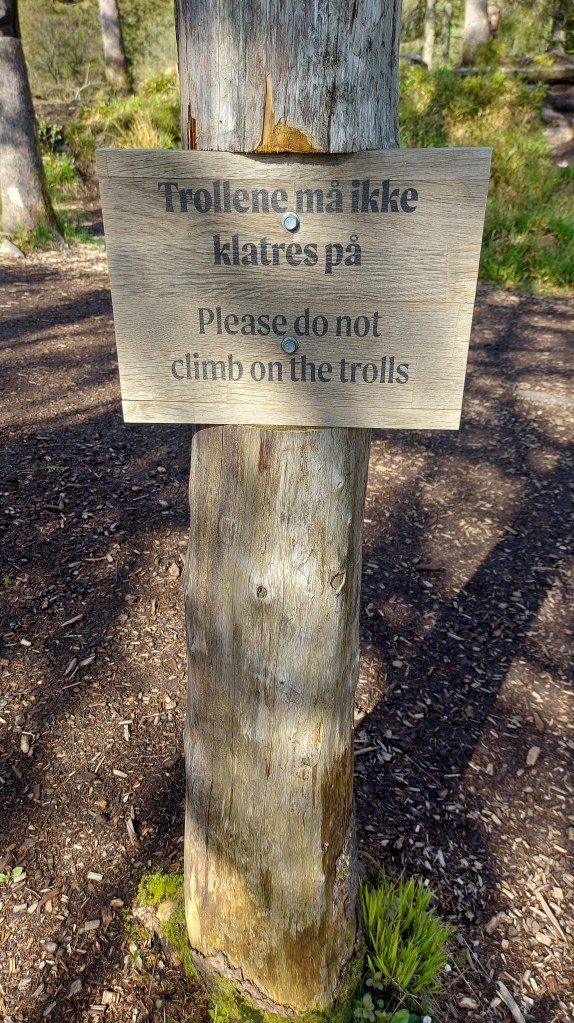
Photo coourtesy of Geoffrey D. Morrison: “a bilingual sign I enjoyed seeing in Bergen”
****
The Coffin Of Honey is available Here.
Falling Hour is available Here.
 lønningspils
Leave a comment