
Review by Gregory Conway.
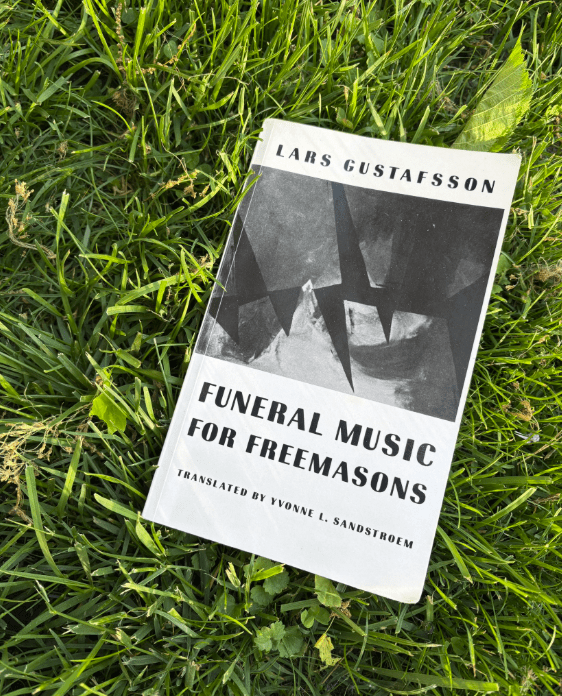
Funeral Music For Freemasons by Lars Gustafsson.
Trans. by Yvonne L. Sandstroem.
New Directions.
91/100.
New Directions has been publishing quite a bit of Nordic literature in the past few years: Helle Helle, Solvej Balle, Olga Ravn and Inger Christensen. The press was founded in 1936 so I decided to take a look back on what hidden Nordic gems might be in the archive and to my surprise I found extremely little. Of course the 2018-2021 run of Dag Solstad books is special, but further than that there is just a 1996 edition of Knut Hamsun’s Dreamers. I was initially very disappointed that my search led to nothing older until I found one writer I’d never heard of – Lars Gustafsson.
Gustafsson was a Swedish novelist and poet, born in Stockholm in 1936 who interestingly spent the years 1983-2003 living in Texas; he returned to Sweden where he passed in 2016, buried beside his close friend Tomas Tranströmer in a graveyard section now known as “poet’s corner”.
****
****
In 1983 Gustafsson published his book Funeral Music For Freemasons, translated by Yvonne L. Sandstroem and released by New Directions in 1987. At the time of publication it was the fifth novel of Gustafsson’s translated into English. At the time of writing it only has 83 readers on Goodreads, we are securely in undiscovered gem territory.
We start our novel in Senegal, where Jan Bohman has unfortunately found himself faced with an inciting incident. Jan has a general store, helps drive tourists around, and is facing some hot water for potentially having some unaddressed nefarious goings-on that are going on. While dealing with a temporary imprisonment and forever deportation from Senegal he reflects back on his life. The novel is split between the current situation in Senegal and memories from his days as a promising young student poet in 1950s Stockholm.
In 1950s Sweden we are primarily concerned with a love triangle between our young up-and-coming poet, an up-and-coming physics researcher, and an up-and-coming opera singer who all show immense promise yet never necessarily succeed in the coming up.
****
There is some kind of old school destructive romantic writing in here that is chianti-soaked and reminds me somewhat of F. Scott Fitzgerald; there is a scene where Jan brings the opera singer, Ann-Marie, back to his hotel room and thinks [“It’s within my power to either destroy or save this person.” And neither was something I really wanted to do.], He also writes of “cold puffs from the sea pulling last year’s oak leaves into aggressive little whirls” which immediately brings to mind the poetic whirling angelica of Tarjei Vesaas in Spring Night. We also unexpectedly find Jan in Senegal “passably shaved, in a passable cotton suit” where he witnesses a truck carrying a load of camels overturn due to a pothole – “The animals, necks broken, were hanging here and there like some kind of fruit. Clouds of black flies over their spilled guts, their long, beautiful legs broken at odd angles, a few vultures flapping above it all. A picture that would have captivated Eugene Delacroix and a bad omen for me”. A pretty gruesome scene that’s quickly snapshotted and left behind, which would fit in nicely in the work of Nikanor Teratologen.
****
There is a somewhat vague Bernhardian thesis that Stockholm’s culture and government led to the inability of these young prospects to really thrive and make a successful career in Sweden, but it doesn’t feel entirely fleshed out, or at least understandable for an outsider without further context on the fifties.
****
FFO: Dag Solstad, F. Scott Fitzgerald, Ebba Haslund.
Buy Here.


Leave a Reply