By Gregory Conway.
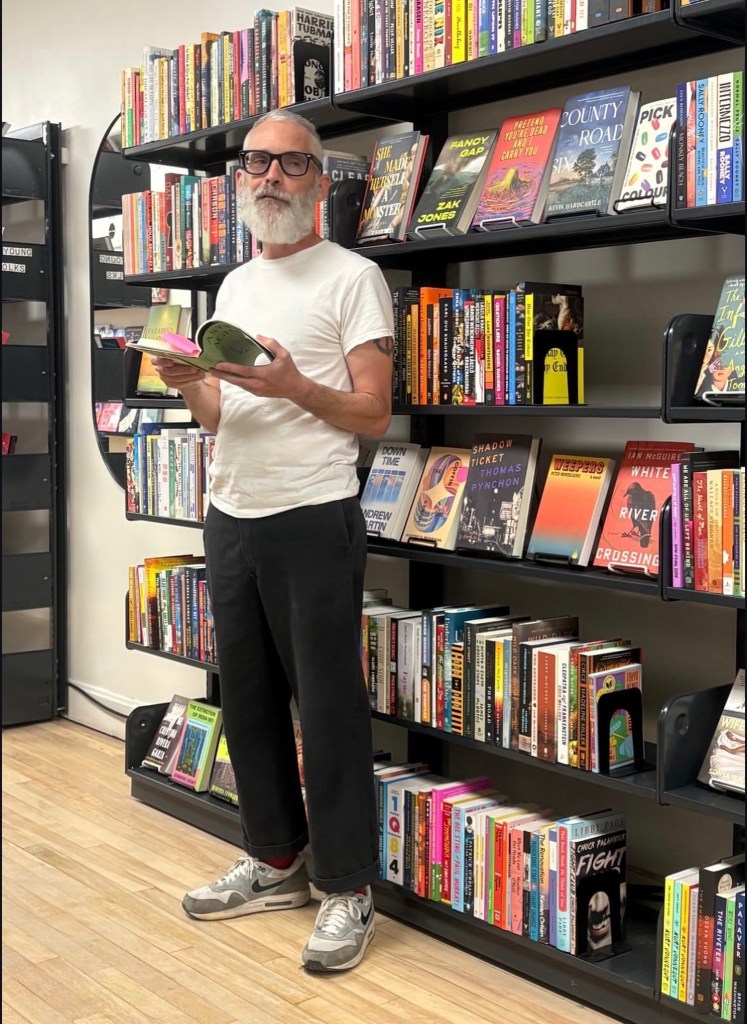
Ian Roy is an author living in Ottawa, Canada. I got introduced to Ian’s work through his Substack Something I’ve Been Meaning to Tell You, which, among other things, chronicled his time writing while in Iceland. HIs most recent book is Astrid, Aghast, a collection of stories put out by the newly revamped Gaspereau Press. He has a collection of essays coming out next spring which should be on your radar.
****
LP: Hello Ian! Thank you for joining Lonningspils for a chat today. How is your morning going? Are you in Ottawa?
IR: Hi Greg. Thanks for having me. I am in Ottawa. And my morning is going well. Just before logging in to the chat, I went outside and trimmed some cilantro in my garden and now all I can smell is fresh cilantro.
LP: I admire your morning yardwork, but to get into it – you’ve just completed a lengthy book tour for your newest release with Gaspereau Press, Astrid, Aghast. You’ve been reading mostly with Jon Claytor, a graphic novelist (& much more), and also some other writers, but uniquely you have also had musicians come aboard – musicians + writers together really seems overpowered and makes for special evenings (extra special when it’s Julie Doiron or Jose Contreras), I am surprised it is not a lot more common. Have you done many readings alongside musicians in the past? & How did it come about?
IR: I’ve done a number of readings with musicians over the years, and sometimes with them even accompanying me while I read—which is so fun, and adds so much to my own experience of reading the stories. I guess this came about simply by having friends who are musicians and putting myself in situations where this can happen. I’ve done this with several of the stories from Astrid, Aghast: with Michael Feuerstack, Jimmie Kilpatrick, Steve Lambke, and of course with Julie and José.
LP: That lineup, of some of my favourite musicians, looks like a dreamy Sappyfest.. which leads me to ask – have you spent substantial time in the East Coast of Canada?
IR: Yes, I have spent a great deal of time in the Maritimes. I lived in Halifax for a couple of years. My oldest son was born there, and while we left when he was only six weeks old, he still tells people that he’s from there. After we left, I made a point of going back East at least once a year. And then when I was involved with SappyFest, I spent a lot of time in Sackville, NB. I still go there at least once a year to visit friends. And now that Gaspereau Press is based there, it’s one more reason to visit.
LP: Haha of course you were involved, that makes perfect sense!
****
****
LP: The newly re-launched Gaspereau Press in Sackville is really doing great work. Astrid, Aghast is a beautiful object. For any paper-heads, it’s a Canson Mi-Teintes cover that just feels awesome to hold & there are some unique properties to the book. The text is left aligned, which is quite rare. There is also a literary equivalent of an Obi strip, with your biography on the back & a rising text swell on page 155’s “what!??”. It is something really worth holding. How important is the physical object and the minutia of a book to you? & did you draw the cover yourself?
IR: It’s funny, having published all of my books with small presses, I’ve always been pretty involved in the production of those books—from design input and layout, to cover imagery and illustrations—but with Astrid, Aghast, I was planning to stay out of it as much as I could. I’m not a designer, I’m not really an artist—so I thought I’d leave it to the pros. But I was asked to contribute some ideas for the cover, so I did that drawing (based on the memory of something I’d seen years ago but couldn’t find) and the simple line drawing of the mountain inside the book, and made some suggestions about the layout… and was reminded how much I care about those things. Ultimately though, it’s Keagan Hawthorne at Gaspereau who is responsible for making the book look the way it does. He’s got a good eye!
LP: To stick on the book – the name Clara appears in several short stories in this collection. Was there a time in the writing process where these stories and multiple Claras were weaved together in a bigger project? Or what decision led to the re-use of the name?
IR: That’s the same Clara who appears in three or four stories. And shows up, though nameless, in at least one other story. At one point, I’d written a very long story about Clara. I wrote and wrote and wrote, and then I chipped away at it until all I was left with were two sentences. There was a time when cutting that much from a story might have broken my heart a little, but now I recognize it as part of my process. I overwrite every story–and then cut away at it until I find the story I was looking for. The other Clara stories in Astrid, Aghast mostly grew out of pieces I’d cut from that long story. Clara was a character I thought about a lot, and so I kept coming back to her. I’m not even sure I’m done writing about her yet.
LP: I hope to one day hear more Clara stories.
****
LP: The title story of your new book, Astrid Aghast, is possibly my favourite in the collection, just a perfect beautiful snapshot of love, which doesn’t feel “corny” or “cringe-worthy” at all, which is one of the hardest things to pull off in literature – in my opinion.. & for the connection to this nordic literary website, the story has references to Denmark – and I believe was written in a library in Iceland. What draws you to the Nordic countries within your work?
IR: I first went to Iceland ten years ago to do some research for a novel for children I was writing at the time (a book called The Girl Who Could Fly). Setting that book in Iceland just kind of happened—the literary history, the culture, the landscape, all of that made it feel like the right place to set my book. After going that first time to work on the book, I knew I had to return. And so I did. And then I just kept going back—always to write, sometimes for a month, sometimes two. There’s a book by Hannah Kent called Always Home, Always Homesick—that captures how I feel about that country. It’s not home, not at all, but it is now familiar and comfortable and a place I love and where I feel like myself. Which is a nice feeling.
LP: As much as Iceland has been a part of your writing, how has it been part of your reading? I recently spent some time going through your Substack “Something I’ve Been Meaning to Tell You” & other than making me go down a long rabbit hole on – Nína Tryggvadóttir – it also showed me a few scattered references to Halldor Laxness. Visiting the museum in Iceland – Halldór Guðmundsson’s biography The Islander hiding in the background of a picture of Icelandic Baking Soda… the readers of Lonningspils will want to know – what’s your favourite Laxness novel?
IR: I started reading Icelandic literature as research for my kids’ novel. At the end of writing that book, I estimated that I read about 100 Icelandic (or Icelandic-adjacent) books. And then I just kept reading Icelandic/Icelandic-adjacent literature. In fact, just yesterday I bought W.H. Auden’s Letters from Iceland (which I’ve already read but didn’t own) and an old book about Surtsey, the island off the coast of Iceland that formed from an underwater volcanic eruption in 1963. As for Laxness… I love Salka Valka. That’s probably my favourite. Archipelago Books put out a beautiful English translation a few years ago, and it’s really great. I also love Under the Glacier. That one helped me see his sense of humour–which was lost on me in the translation of Independent People (which I was told by a translator does have some humour in it–I just didn’t see it.) Oh, and I recently read A Parish Chronicle, which I enjoyed. That one was also published by Archipelago Books. Their books remind me a little of Gaspereau’s books–really beautifully made objects.
LP: Salka Valka is also my favourite – yes, I feel the same way. In translation it feels like he has comic novels and his serious epics, but it makes sense its more intertwined in the original. I actually just read that Auden book for the first time a week or two ago, a very fun and unique Auden book. To end on, I wanted to bring up skateboarding. Of course there are prodigies, but generally, you have to be really bad at something, with determined dedicated practice for a very-very-very long time to be a skater. In this way it is sort of like writing. What is your relationship with skateboarding & how does skateboarding fit into your life and creative practice?
IR: I’ve been skateboarding since I was a kid. I think about it constantly. I talk about it all the time. I go skateboarding most days when I’m able (read: when I’m not injured because of skateboarding). My oldest, closest friends came to me through skateboarding. It’s a big part of my life and how I see and navigate the world. It taught me how to be creative before I even had a name for that. A big part of skateboarding is finding creative ways to use everyday objects (a curb, a wall) in creative ways. It also taught me how to embrace failure. I fall all the time when I’m trying to learn some new trick (or just when I’m rolling down the street). This is just the reality of skateboarding. But then I get back up and try the trick again. And again. And the only reason for doing this is for the joy it brings me, the feeling of having done a thing. The same can be said of writing. I fail all the time. Things usually don’t come out how I intended them to. So I try again, and hope the next time it will be better.
LP: Ian… thank you so much for your time. I am really happy to have read Astrid Aghast and look forward to tracking down your older books in the near future. Enjoy the rest of your day and we will get together for coffee in Ottawa in the fall!
****
Astrid, Aghast is available here.
This interview has been edited for length and clarity.
 lønningspils
Leave a comment