
Review by Timothy Berge.
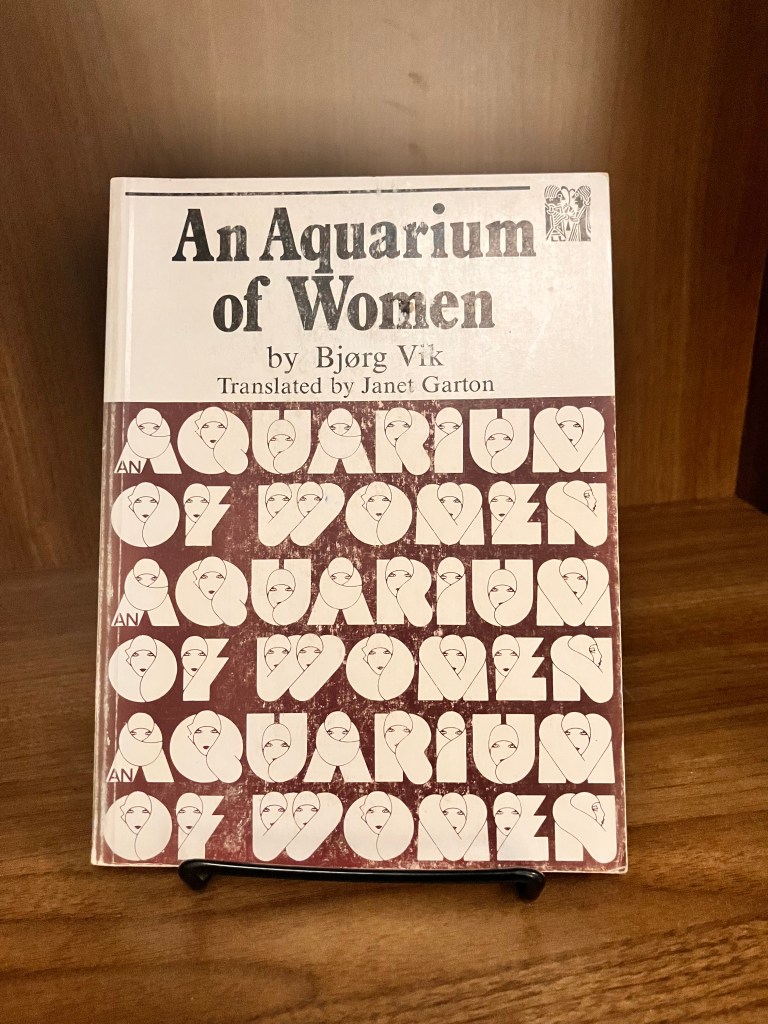
An Aquarium of Women by Bjørg Vik.
Trans. by Janet Garton.
Norvik Press.
85/100.
****
To the English reading world there is not much information about Bjørg Vik. She was born in Oslo in 1935 and died in 2018. She worked as a journalist, but cut back to focus on her literary writing and children. Her genre of choice was the short story because the demands of motherhood made it challenging to sustain longer projects. In 1963 she published her first collection of short stories. In 2002 she published her last collection of short stories. In between the two collections she wrote nearly thirty books as well as several plays and radio scripts. Despite her popularity in Norway, only two of her books have been translated into English—An Aquarium of Women and Out of Reason and Other Stories. Both out of print. The Bloomsbury Guide to Women’s Literature ends its short blurb on Vik, “[she] has been surprisingly little translated.”
And it is surprising.
An Aquarium of Women was Vik’s fifth book. Published in Norway in 1972, Janet Garton translated the collection into English and the inimitable Norvik Press put it out in 1987. It is a collection of short stories divided into three sections. Each section contains three stories. Each section focuses on women at different stages of life. The first section is adolescent girls recognizing for the first time that the world they inhabit has a separate set of rules and expectations for men and women. The second section centers women in early to mid adulthood stifled by the invisible systems governing everyday life. The third section moves beyond the home, the workplace, and the nuclear family to show women trying to live liberated lives free from conformity and oppressive societal structures. The collection provides the sensibility of a bildungsroman, but rather than following a single character from adolescence into adulthood the stories trace gender and class inequality from girlhood into middle age.
The first section begins with “Sunday 43.” On a Sunday in 1943 during Germany’s occupation of Norway Margaret, Gerd, Ruth, and Anita walk to church. They whisper. They gossip. They see children from an orphanage who are also going to church. They sing and listen to a sermon. After they go their separate ways. Gerd sits on the kitchen window sill. She goes out. Meets up with Ruth. They gossip more. They spit. They tease. They go home. Gerd sits in a room with her mother and Aunt while Gerd’s dad is out drinking. Gerd looks through her aunt’s handbag. A mirror. Cigarettes. Perfume. Ration cards. All the things a woman needs. She puts some perfume behind her ears and her aunt tells her she will be a dangerous lady. It’s a mundane afternoon in Norway. It’s 1943. Before bed Gerd worries about air raids and wonders why God gave his only begotten son. Wouldn’t a daughter be just as good?
The second story, “It’s Good To Be on the Bus,” follows a family from the city on a visit to relatives in the country. They ride a bus out of town. The country relatives boast about country life. The air is cleaner and there are no air raids. The girls pick berries. The country girls chastise the city girl for not being able to do country things like walk on stilts and peel potatoes. They tease her for having a telephone and a bathtub. Everyone who lives in the city is stupid, they say. Being in the country is alienating and uncomfortable, but she takes in all the sounds, smells, and experiences. She feels safe in the discomfort and as she rides the bus back to town she feels content.
“Back Yards,” the final story of the adolescent section is about a friendship that falls apart because of class division and upward mobility. Tora and Lillian are best friends. Lillian starts to hang out with Benedikte. Benedikte’s family is wealthy. Her mother plays violin. Lillian likes spending time with Benedikte because she enters a world of culture otherwise closed off to her. The friendship between Lillian and Benedikte essentially ends the friendship between Lillian and Tora. Tora is too uncivilized. She is not upwardly mobile like Lillian. As time passes Tora becomes a pariah. Lillian will get an education and a job. She will become a cultured woman. Tora will stay in their sad, small town. She will follow a predetermined script for poor, working class women.
What connects these stories are long unbroken paragraphs and the way in which they identify a gap between lives. The orphan girls and Gerd and their friends. Gerd’s mother and aunt at home and her father out drinking. The country girls and the city girls. Benedikte and Tora. Juxtaposing lives underscore inequality in various forms and the many ways one can be oppressed. The girls are only becoming aware of the gaps between how they live and how other people live. The long sentences spilling into long paragraphs suggest an unfragmented existence. The gaps are not fully formed. With age come bigger gaps. With these gaps comes a splintered existence.
****
****
The second section shifts the style. There are paragraph breaks and section breaks. The world of adult women is more fragmented than the world of adolescent girls. With the fragments come gaps in prose, in experience, in class, and in gender. The cluster of stories opens with “Climbing Roses” where sections alternate between sketches of households in a single neighborhood and journals from a teenaged girl living in the neighborhood. The journals are angsty. Her parents don’t care about the environment. They only care about throwing parties. They have forgotten their working class roots and have comfortably settled into a bourgeois life that offends her. The household sketches further illustrate the status quo the teenager fights against. Jobs. Families. Pets. Exercise. Wine. Comfort.
The textual gaps continue as do the gaps between experiences. “Liv” is a story about a woman polishing plates in a factory. People who run a factory and work on a factory floor live different lives. The men who work on the factory floor and the women who work on the factory floor live different lives. Liv notices the difference between these lives. Her male coworkers encourage her to attend union meetings. For the working conditions to improve for everyone, she needs to participate in union organizing activities. It is her responsibility according to the men she works with to make improvements in the world. But she’s too tired. She is drained and dulled by the monotony of life. She takes comfort in the dullness, but wonders if it could have been different. Probably not.
Hasn’t she just got herself to thank for it all?
That she didn’t get some higher education, a different job or a different husband? She has often thought about that, worried at the thought, reproached herself for not being a different person.
Now she thinks differently: there is something behind it, something she can’t see clearly but can make out the shadow of. That a game is being played with people like her and Sven, that are being drained and used and have not enough strength left to turn the game in their favour. And that that is what the game is about, that is what is happening all day long. And has been happening as long as she can remember, from when she left school, the whole time she lived at home and wished herself somewhere else, wished for something else, other things around her, other clothes, other people. When she went through the factory gates that first day, was she the on who chose it? Or was it something which had made her like that, so that she only had that gate to go through? (p. 54)
She did not choose her life. There is a system and Liv is guided through the system. Moments of freewill only provide the feeling of freedom. She is trapped. No control. Liv wonders who are the people that run this system that directs her life. She doesn’t know them, doesn’t see them. “The thought takes shape inside her, becomes a scream inside her: who are they, what do they look like, the people who have made her life like this?” (p. 55). There is a gap between the life she wants and the life she has and she is powerless to alter the size of the gap.
The final story in the second section “Emilie” updates Ibsen’s A Doll’s House. Emilie is a librarian. Her husband is a teacher. They have two children. As it was for Liv, life is repetitive, “there is nothing to be surprised about anymore” (p. 58). Every aspect of her life is scheduled and carefully cultivated. It is predictable and dull. Unlike Liv, she does not find comfort in the dullness. Emilie’s life used to have meaning, but that meaning is gone now:
Previously she had often felt that Meaning was there, right behind something which was happening, just beside words which were being said; all she needed was to reach out her hand and the curtain would be rent. It was there – she just couldn’t see it. The feeling was so strong, almost a certainty, so it wasn’t necessary to make a great effort to grasp it. Since then she has thought that the feeling of meaningfulness was actually a sense of expectancy, you thought that you had so much in store, so much to look forward to; expectancy must have been a powerful driving force. (p. 61)
Meaning has left the lives of Emilie and her friends. They no longer know anything about the world or about themselves. Emilie has a mental break. She leaves her job and family to stay at a mental hospital. Once healthy she writes Jon, her husband, a letter. In the letter she explains that she isn’t coming home. She is going out on her own free from the obligations of work and family. She needs to be free from the pressures and expectations of her work and family in order to live a fulfilling life.
****
The final cluster of stories demonstrate the joy that can be found in escaping the systems of oppression that forms everyday life while at the same time highlighting freedom is more complicated than quitting a job and leaving a husband. Being free from family and work does not guarantee a free and meaningful life as demonstrated in the final story, “After All The Words,” where a woman traveling abroad begins a relationship with a fellow communist. The story, which is more like a manifesto than a story, underscores the power imbalances in personal relationships and how those power imbalances make any conception of freedom false.
He asks me where I get my freedom from.
Freedom?
I know less and less about that, about what it is. It feels like a hard naked knot, I’m not sure that’s what it ought to feel like (p. 100)
The stories in the third section move away from homelife in Norway. The women are no longer young women living with their parents nor are they homemakers with jobs and children. They are potential versions of Emilie after leaving her family. In “Take Nothing With You On The Way…” a woman finds joy in the normality of life. A child burping. A wasp in someone’s hair. Leaves falling from a tree. It’s a monologue to a lover and perhaps the only sustained happiness in the book.
The women in the last two stories “Greetings From The Land Of The Weeping Willows” and “After All The Words” don’t share the same joy. Instead they feel constrained by personal relationships. Sometimes it’s because of the difficulty of establishing deep connections with people. Sometimes it is because in order to establish a deep connection you give up your individuality, which leaves you vulnerable. A woman questions the value of political independence because interpersonal relationships will always contain power imbalances that disproportionately harm women, “What good is material and economic independence, I ask, if anyone can always abuse us emotionally? If someone always has that power over us?” (p. 106).
Many of Vik’s characters are socialists but her stories always highlight the gap between male socialists and female socialists. In Liv’s story she is encouraged by male coworkers to attend union meetings but the request ignores the burden most working women bear at home. They don’t have time to keep a house and a job and attend union meetings. “After All The Words” emphasizes this point:
Often they talk about workers and their cause, seldom about women. That is so self-evident you don’t waste time on it. There is an immeasurable distance between the words and what they are talking about. Some of them are aware of that distance, and it becomes part of their despair and their honesty. They sit there knowing that it is a long-drawn-out and wearisome process, weighed down by the knowledge; it is that which makes their hands move slowly, their smiles come slowly. (p. 103)
There is a gap between workers and the system they work in. There is a gap between men and women, between boys and girls. There is a gap between the words we use and the things we are talking about. These gaps exist every day in every aspect of life. Vik was excellent in exposing gaps. There is also a gap in quality among the stories in An Aquarium of Women. At times the stories take a backseat to political messaging. The politics are agreeable, but the balance is off. Still, An Aquarium of Women is a remarkable book. The final gap exposed in An Aquarium of Women is the gap between her quality, her popularity in Norway, and her lack of reputation in English.
FFO: Grace Paley, Tove Ditlevsen, Elena Ferrante, Tillie Olsen.


Leave a Reply